Frida Kahlo: The Long Journey Towards Casa Azul
Some artists arrive in your life for a single moment. Others stay across decades, in different cities, exhibitions, books and rooms, until you realise you have been following them around the world. For me, that artist has been Frida Kahlo.
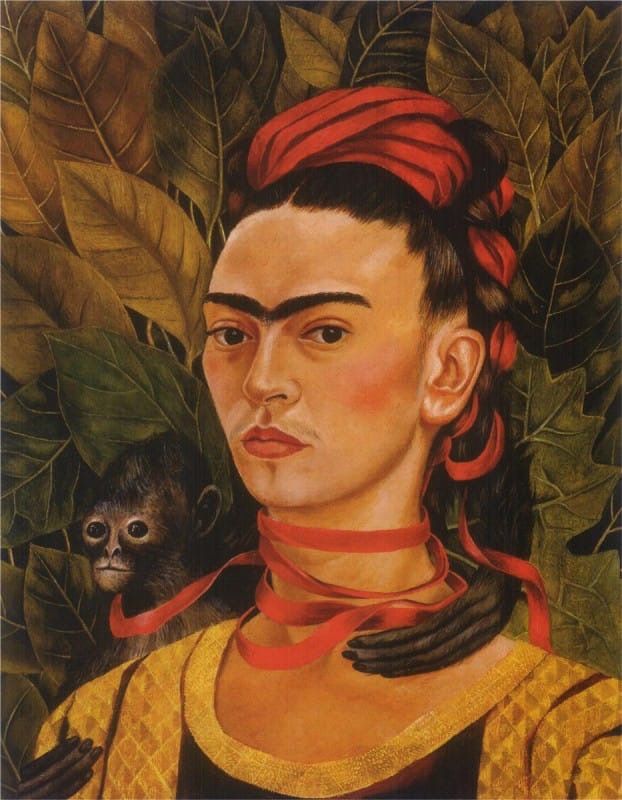
In autumn 2001, Tate Modern was showing Surrealism: Desire Unbound, and Madonna had loaned one of the masterpieces from her own collection: Self-Portrait with Monkey, painted in 1940, the year of Frida’s painful divorce from Diego Rivera. I stood in front of it and fell in love at once. A beautiful young woman against a backdrop of green leaves, the famous unbroken brow, a silky red ribbon winding through her hair, the shoulders of a traditional dress. Her gaze does not meet yours — it slides off to the right — but the small monkey curled against her neck looks straight out. And in the soft light, there is a faint down on her upper lip. The painting is a study in skill, technique and imagination.
I went away and read Hayden Herrera’s biography — still, I think, one of the finest books ever written about an artist. Herrera made me understand that Kahlo’s work could not be separated from her life. Every canvas carries traces of suffering, betrayal, longing and survival.
Then came the film Frida. Salma Hayek was extraordinary, born to play this role — beautiful, intelligent, defiant, funny as well as broken. She brought the artist and the woman in the paintings to life.
Then in 2005, Tate Modern gave Frida her first solo exhibition in Britain. Some of the paintings were physically small, yet I found myself leaning into them, pulled into details that felt private, even confessional. They are based on votive paintings, which are small devotional images traditionally left in Catholic churches as offerings of thanks or prayer, showing scenes of illness, accidents, danger, or survival.
The centrepiece was The Two Fridas — a double self-portrait, one Frida in Tehuana dress, the other in Victorian lace, seated side by side beneath a stormy sky and joined by a single exposed artery. One loved. One unloved. Again, you could stand in front of this painting for hours, identifying all the minute detail.
Over the years, Frida kept reappearing.
In March 2018, in Santiago, Chile, I came unexpectedly across an exhibition of photographs of her with Diego. Then that August came the V&A in London — extraordinary not for the paintings but for what surrounded them: clothes, corsets, make-up, prosthetics, bottles of medicine. It felt like the contents of Casa Azul had been transported across the Atlantic to London.
With every encounter I understood her better. Beyond the body in pain there was the dramatic love life — affairs with women as well as men, an entanglement with Trotsky during his exile in the Blue House — and the steady Communist conviction that ran beneath everything she painted.
Rivera betrayed her repeatedly, but she remained magnetically attached to him. Their marriage seems to have contained passion, rivalry, companionship, infidelity, tenderness and mutual artistic admiration all at once.
But Frida’s emotional world was shaped long before Rivera. Her relationships with her mother, father and sisters echo through the paintings. And the body she would paint so unflinchingly was already marked.
At six she contracted polio. Her right leg came out of it thinner than the left, the foot smaller. She spent months alone in her room. Other children took to calling her Frida pata de palo — Frida wooden leg. The limp stayed with her. So did the long skirts.
Her father set her to swimming, cycling, football, even wrestling — almost unthinkable for a girl in Mexico at the time.
Then, at eighteen, the accident. A tram struck the bus she was riding through Mexico City. Fractures of the spine, the pelvis, the leg. Years of operations, corsets, miscarriages, convalescence. The children she would never have.
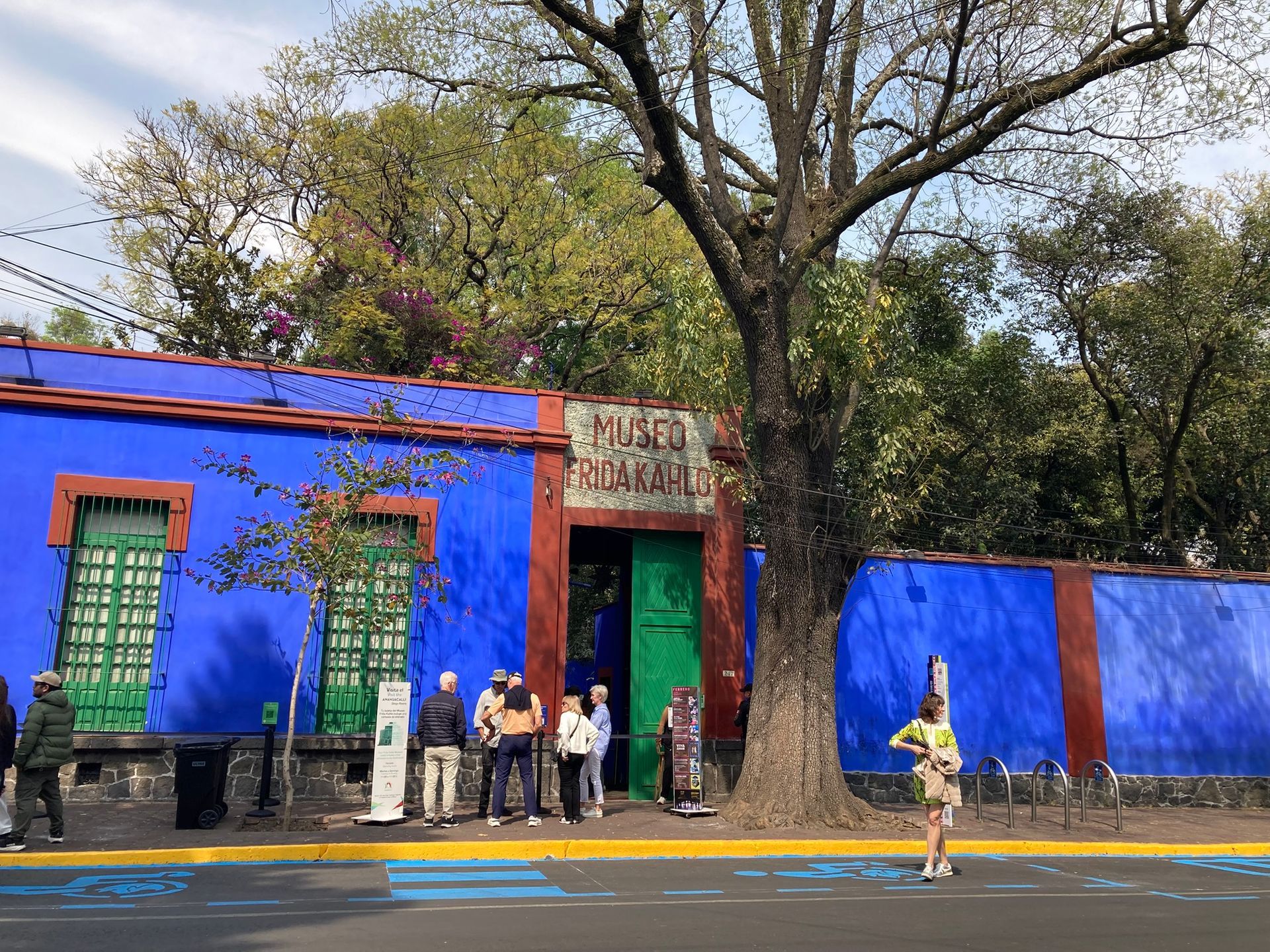
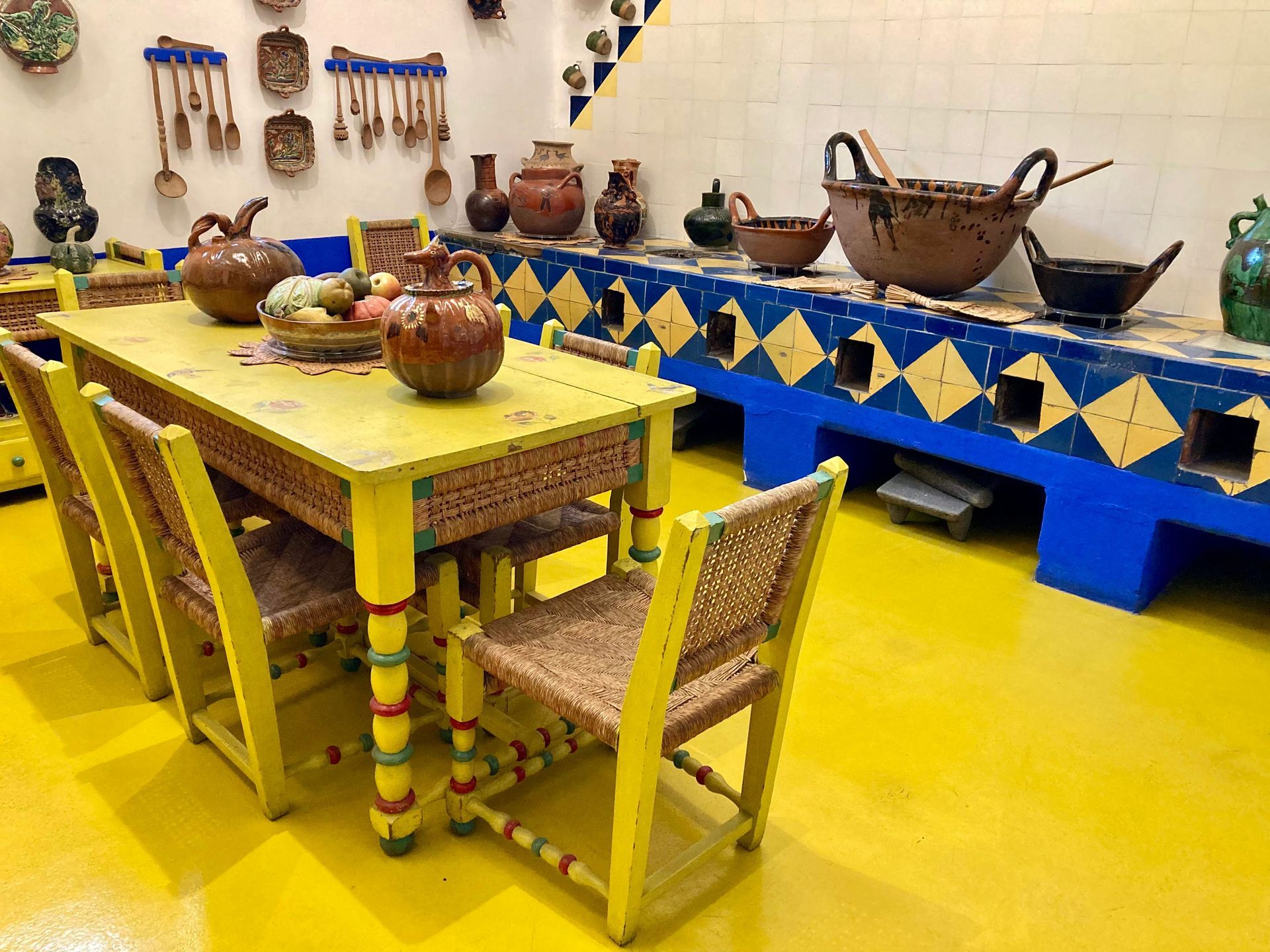
Finally, this year — I visited Casa Azul. After more than two decades of reading and watching and visiting exhibitions, arriving at the Blue House in Mexico City felt quite emotional. The cobalt blue and the terracotta were instantly recognisable. But what stays with me more than the colours is the kitchen, the studio, the mirrors, the books, and the wheelchair beside the easel.
Later, in Oaxaca, at the Museo de la Filatelia, I saw her letters to Dr Leo Eloesser — written on hotel letterhead from New York and Detroit, the looping handwriting filling both sides of the page. In one, from Detroit in 1932, she describes a pregnancy she has just lost: her Dieguito chiquito, her little Diego. In the next sentence, she says there is no remedy now but to endure it.
This summer, Tate Modern in London opens Frida: The Making of an Icon — the first major UK retrospective in over twenty years, running 25 June to 3 January. I gather the final room will be given over to Fridamania: more than two hundred licensed objects bearing her face, from tote bags to tequila to fridge magnets.
I cannot quite imagine what she would have made of that.