Frida Kahlo: The Long Journey Towards Casa Azul
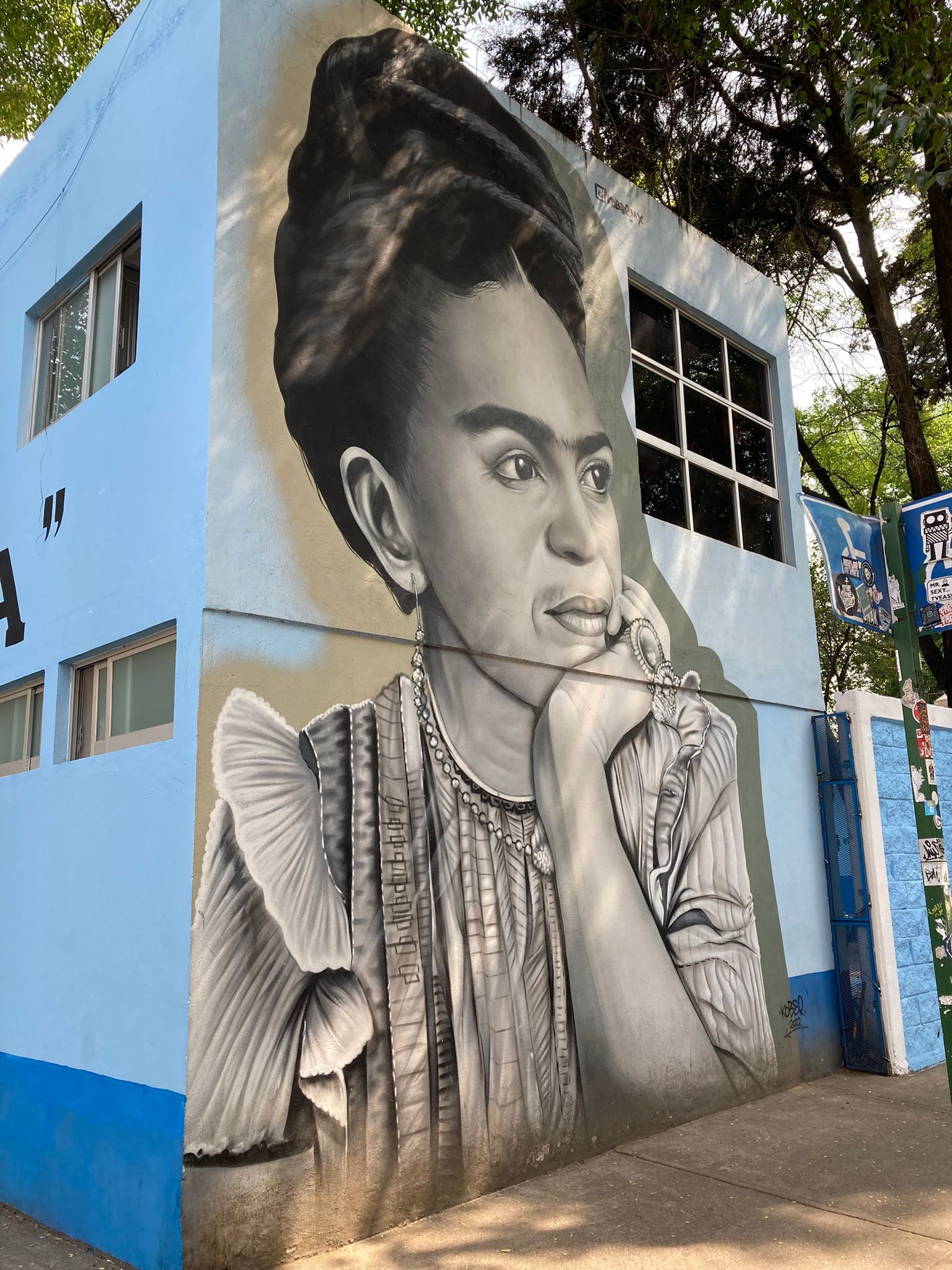
Some artists arrive in your life for a single moment. Others stay across decades, in different cities, exhibitions, books and rooms, until you realise you have been following them around the world. For me, that artist has been Frida Kahlo.
In autumn 2001, Tate Modern was showing Surrealism: Desire Unbound, and Madonna had loaned one of the masterpieces from her own collection: Self-Portrait with Monkey, painted in 1940, the year of Frida’s painful divorce from Diego Rivera. I stood in front of it and fell in love at once. A beautiful young woman against a backdrop of green leaves, the famous unbroken brow, a silky red ribbon winding through her hair, the shoulders of a traditional dress. Her gaze does not meet yours — it slides off to the right — but the small monkey curled against her neck looks straight out. And in the soft light, there is a faint down on her upper lip. The painting is a study in skill, technique and imagination.
I went away and read Hayden Herrera’s biography — still, I think, one of the finest books ever written about an artist. Herrera made me understand that Kahlo’s work could not be separated from her life. Every canvas carries traces of suffering, betrayal, longing and survival.
Then came the film Frida. Salma Hayek was extraordinary, born to play this role — beautiful, intelligent, defiant, funny as well as broken. She brought the artist and the woman in the paintings to life.
Then in 2005, Tate Modern gave Frida her first solo exhibition in Britain. Some of the paintings were physically small, yet I found myself leaning into them, pulled into details that felt private, even confessional. They are based on votive paintings, which are small devotional images traditionally left in Catholic churches as offerings of thanks or prayer, showing scenes of illness, accidents, danger, or survival.
The centrepiece was The Two Fridas — a double self-portrait, one Frida in Tehuana dress, the other in Victorian lace, seated side by side beneath a stormy sky and joined by a single exposed artery. One loved. One unloved. Again, you could stand in front of this painting for hours, identifying all the minute detail.
Over the years, Frida kept reappearing.
In March 2018, in Santiago, Chile, I came unexpectedly across an exhibition of photographs of her with Diego. Then that August came the V&A in London — extraordinary not for the paintings but for what surrounded them: clothes, corsets, make-up, prosthetics, bottles of medicine. It felt like the contents of Casa Azul had been transported across the Atlantic to London.
With every encounter I understood her better. Beyond the body in pain there was the dramatic love life — affairs with women as well as men, an entanglement with Trotsky during his exile in the Blue House — and the steady Communist conviction that ran beneath everything she painted.
Rivera betrayed her repeatedly, but she remained magnetically attached to him. Their marriage seems to have contained passion, rivalry, companionship, infidelity, tenderness and mutual artistic admiration all at once.
But Frida’s emotional world was shaped long before Rivera. Her relationships with her mother, father and sisters echo through the paintings. And the body she would paint so unflinchingly was already marked.
At six she contracted polio. Her right leg came out of it thinner than the left, the foot smaller. She spent months alone in her room. Other children took to calling her Frida pata de palo — Frida wooden leg. The limp stayed with her. So did the long skirts.
Her father set her to swimming, cycling, football, even wrestling — almost unthinkable for a girl in Mexico at the time.
Then, at eighteen, the accident. A tram struck the bus she was riding through Mexico City. Fractures of the spine, the pelvis, the leg. Years of operations, corsets, miscarriages, convalescence. The children she would never have.
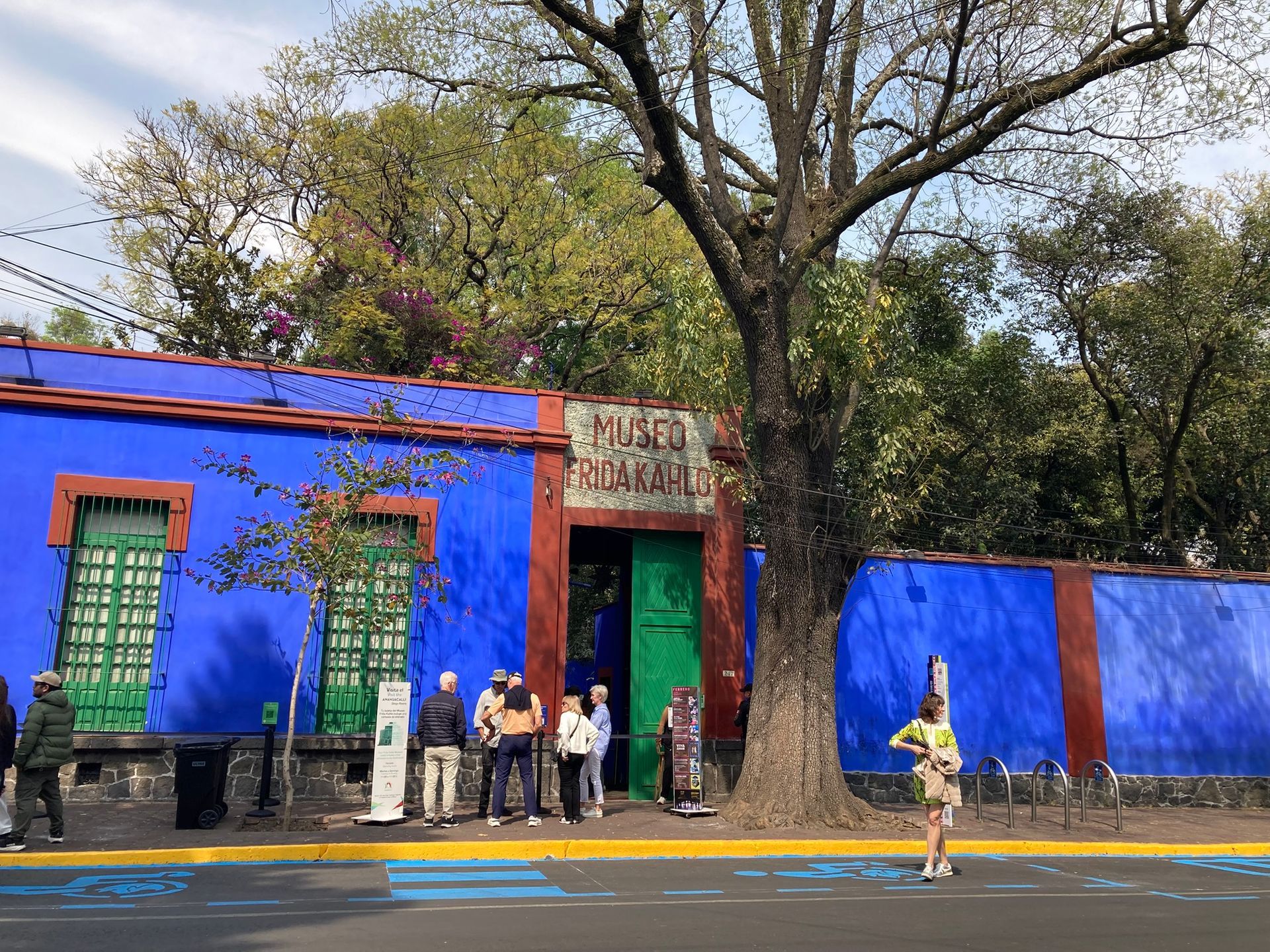
Finally, this year — I visited Casa Azul. After more than two decades of reading and watching and visiting exhibitions, arriving at the Blue House in Mexico City felt quite emotional. The cobalt blue and the terracotta were instantly recognisable. But what stays with me more than the colours is the kitchen, the studio, the mirrors, the books, and the wheelchair beside the easel.
Later, in Oaxaca, at the Museo de la Filatelia, I saw her letters to Dr Leo Eloesser — written on hotel letterhead from New York and Detroit, the looping handwriting filling both sides of the page. In one, from Detroit in 1932, she describes a pregnancy she has just lost: her Dieguito chiquito, her little Diego. In the next sentence, she says there is no remedy now but to endure it.
This summer, Tate Modern in London opens Frida: The Making of an Icon — the first major UK retrospective in over twenty years, running 25 June to 3 January. I gather the final room will be given over to Fridamania: more than two hundred licensed objects bearing her face, from tote bags to tequila to fridge magnets.
I cannot quite imagine what she would have made of that.
Mexico City:
Four Days That Were Never Going to Be Enough!!
We spent four nights in Mexico City, based in the Centro Histórico at the Hotel Bellas Artes. It was our first time in the city and we tried to cover as much ground as we could without turning it into a sprint.
The obvious starting point was the Museo Nacional de Antropología in Chapultepec, and it lived up to everything we had read about it. It is one of the great museums of the world.
In the evening we ate at Casa de Azulejos, the famous building on Madero whose exterior is entirely covered in blue and white Talavera tiles. We ended up in their informal restaurant rather than the main dining room, which was fine. Our waiter was the highlight of the evening. He spoke to us for a long time in Spanish about regional differences in the language — how people spoke differently in Mexico City compared to Oaxaca — and told us that his family history included conquistadores, which he mentioned without any particular weight, simply as a fact. We talked about the regional languages of Spain and the English north-south divide. He understood exactly what we meant.
— — —
On our second day we went to Coyoacán. Casa Azul, Frida Kahlo’s home, was one of the best artists’ house museums we had visited anywhere. The number of visitors is capped per session so it never felt crowded, and the house felt genuinely lived-in rather than preserved behind barriers. You could see her bed with the mirror above it that her parents had fitted so she could carry on painting during her long recoveries. The easel was built specifically for her wheelchair. The medical corsets she painted to make them decorative rather than just functional were displayed in the studio. The yellow kitchen was vivid and warm. Her political books and photographs of Lenin, Stalin and Mao were arranged exactly as she had left them.
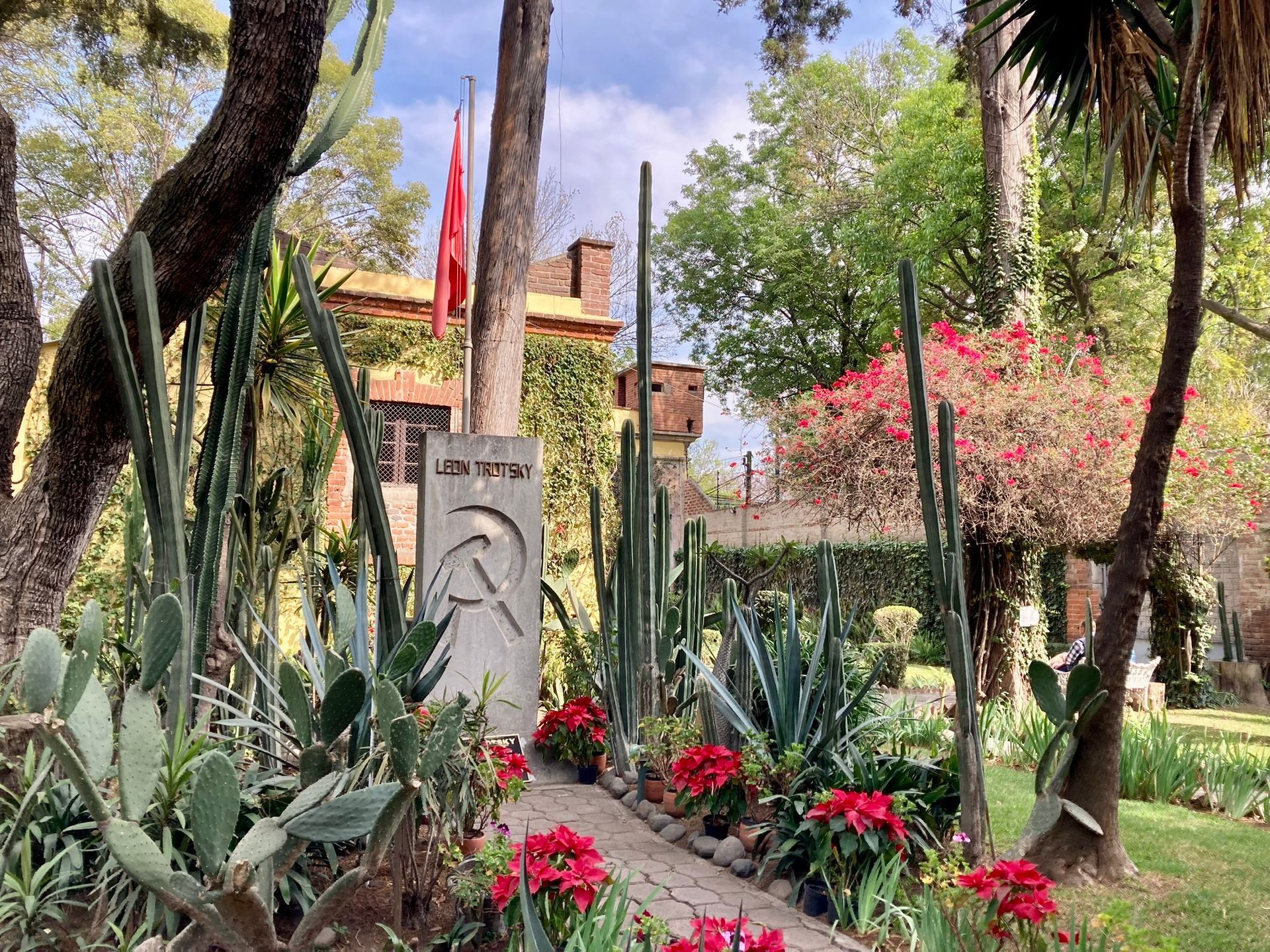
Around the corner, Trotsky’s house told a very different story. It felt more domestic than we expected — there were rabbit hutches in the garden and an ordinary open icebox in the kitchen — but the history was brutal. The internal doors had been reinforced like bank vaults after the first assassination attempt in 1940, when David Alfaro Siqueiros, the muralist and Diego Rivera’s comrade, arrived with twenty men in military uniforms and machine-gunned the bedroom. Trotsky and his wife survived by rolling under the bed. Later that year, Ramón Mercader, a Spaniard working for Soviet intelligence who had spent months gaining Trotsky’s trust, killed him with an ice axe in the study. The study is preserved exactly as it was: books, papers, a pen. The bullet holes in the bedroom wall are still visible.
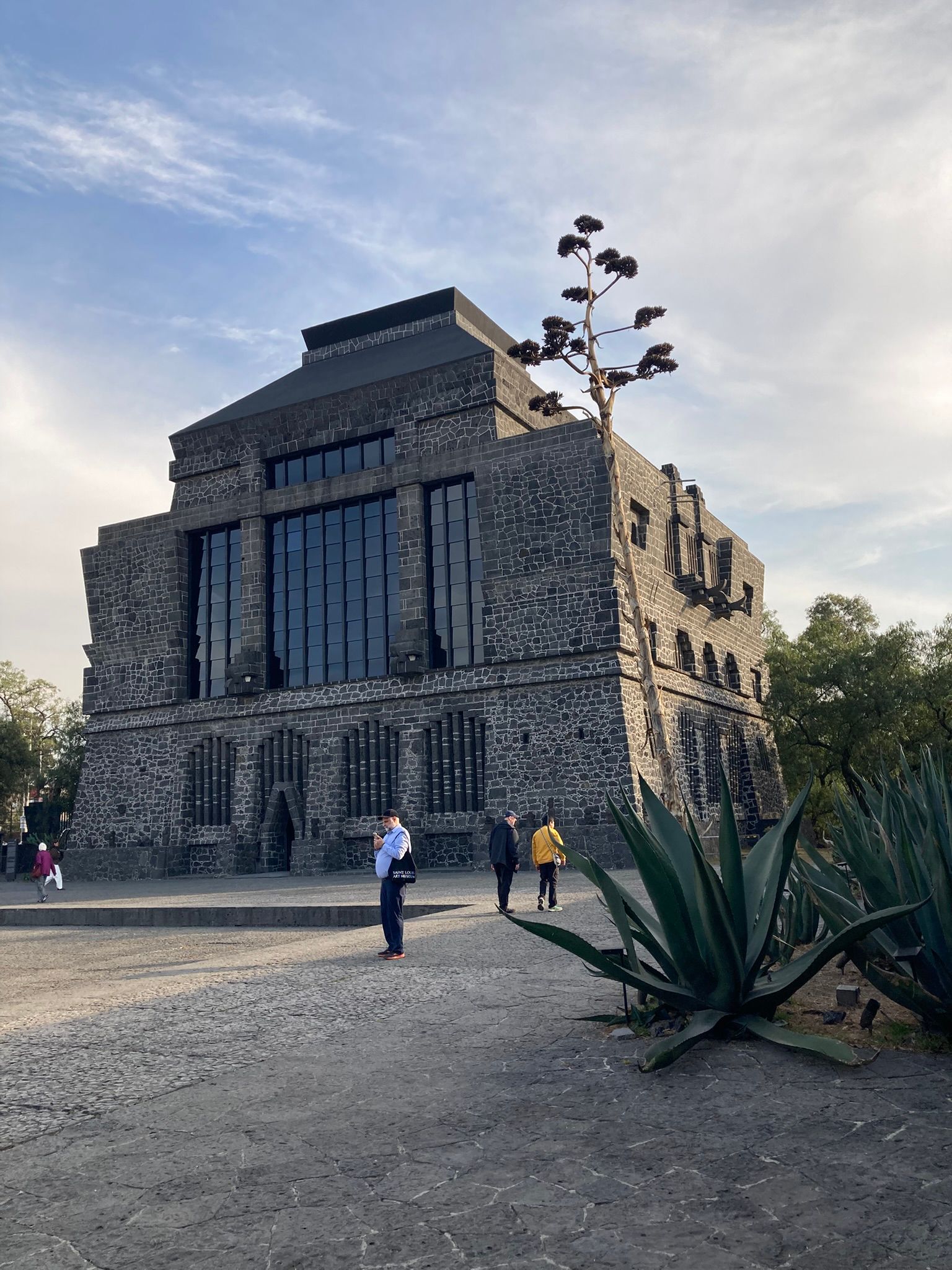
Our third stop that day was the Museo Anahuacalli, Diego Rivera’s self-designed pyramid on the edge of the city. He built it from volcanic stone to house his collection of pre-Hispanic clay artefacts — around fifty-nine thousand pieces in total, of which roughly two thousand are on display. The building sits in the landscape like a temple and the roof terrace has great views over the city toward the volcanoes. The details are in the design of this temple, inside and out, it feels like a ‘folly’ for Rivera’s artistic style.
— — —
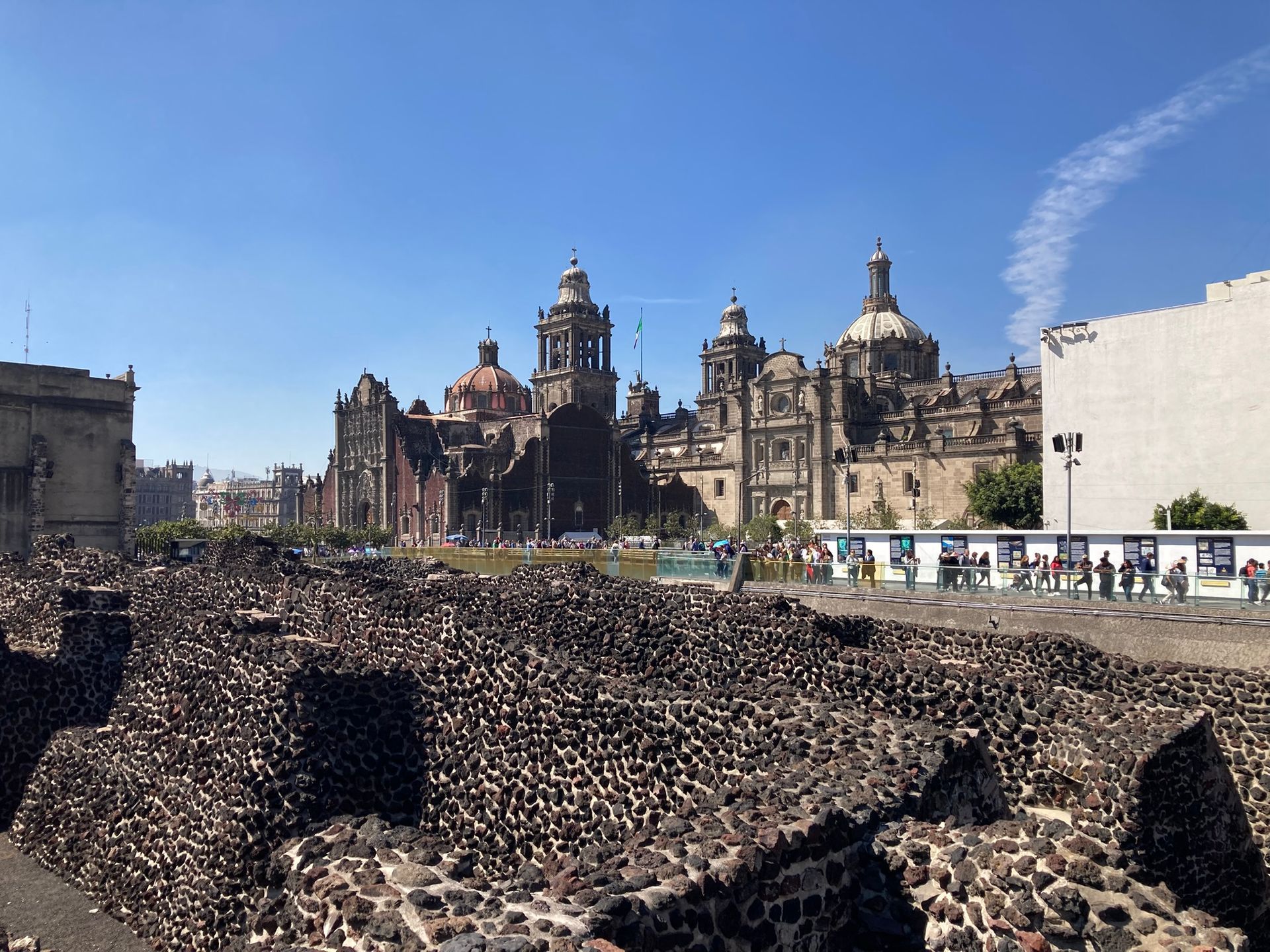
The Zócalo was central to our third day. It is the largest city square in the Americas. Standing at the centre with the Metropolitan Cathedral on one side and the Palacio Nacional on another, you should be aware that beneath the square lay Tenochtitlán, the Aztec capital that was dismantled by the Spanish after 1521 and built over. The Templo Mayor, the ceremonial centre of that city, was not rediscovered until 1978 when electricity workers found the Coyolxauhqui stone — a large carved disc depicting a dismembered goddess — while laying cables nearby. The excavation that followed has been one of the most significant in the Americas and is still ongoing.
The Templo Mayor was rebuilt seven times, each ruler encasing the previous structure within a new one so the pyramid grew with each reign. The carved eagles, frogs and serpents along the ceremonial banquettes were cosmological rather than decorative: each animal carried a specific meaning within the Aztec understanding of the world. The recently excavated Huey Tzompantli, the skull rack, confirmed on an enormous scale what Spanish accounts had described — ritual sacrifice was not peripheral to Aztec life but central to it. The Spanish dismantled the Templo Mayor and used its stones to build the Cathedral that stands directly beside it. The museum attached to the site was clear and well laid out.
In the afternoon we went to the Secretaría de Educación Pública to see Rivera’s murals. There were more than two hundred panels across three floors: Mexican history, labour, politics and identity painted on a vast scale. Miners, weavers, a banquet of billionaires, Frida Kahlo distributing rifles.
— — —
On Sunday morning we went to the
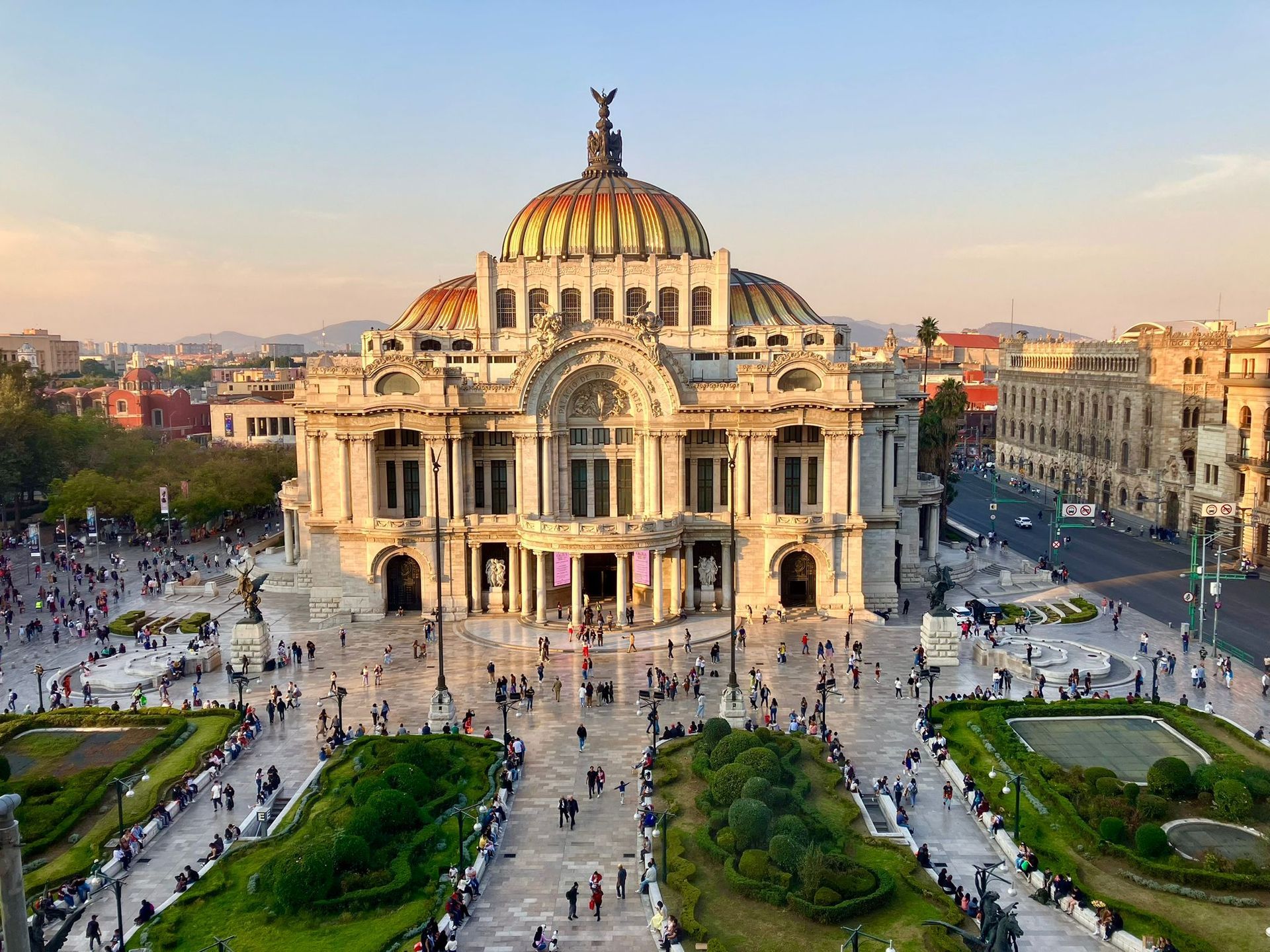
Palacio de Bellas Artes to see Ballet Folklórico de México performed. The company who performed this was founded in 1952 with eight dancers and now puts fifty people on the stage. The Tiffany-glass curtain beautifully depicted the volcanoes Popocatépetl and Iztaccíhuatl lit from behind in shifting colours. There were regional dances from across Mexico: women in huge yellow and pink skirts performing La Sandunga with flowers balanced on their heads, a blue skeleton with extravagantly flexible legs, two mariachi harpists competing with each other, a man trying and eventually managing to lasso the woman he was after. La Cucaracha brought the house down. The singing was as good as anything we had heard. We had bought gallery tickets, which worked perfectly well.
Then after coffee in the Palacio de Bellas Artes cafe, we visited the Museum de Bellas Artes, upstairs. There were sculpture and art galleries, and murals by Rivera and Siqueiros. These are what we had really come to see in the museum. Rivera’s Man at the Crossroads was a recreation of the mural destroyed at the Rockefeller Center after Nelson Rockefeller objected to Lenin’s face in it. Siqueiros’s New Democracy on the opposite wall is a very different kind of painting: foreshortened figures erupting toward you, painted with industrial materials, confrontational rather than explanatory. It was interesting to stand in front of the murals by Rivera and Siqueiros and contemplate their relationship with each other, with communism and with Trotsky. We considered the connection between art and politics presented here, and were sure there was nothing similar at home in England.
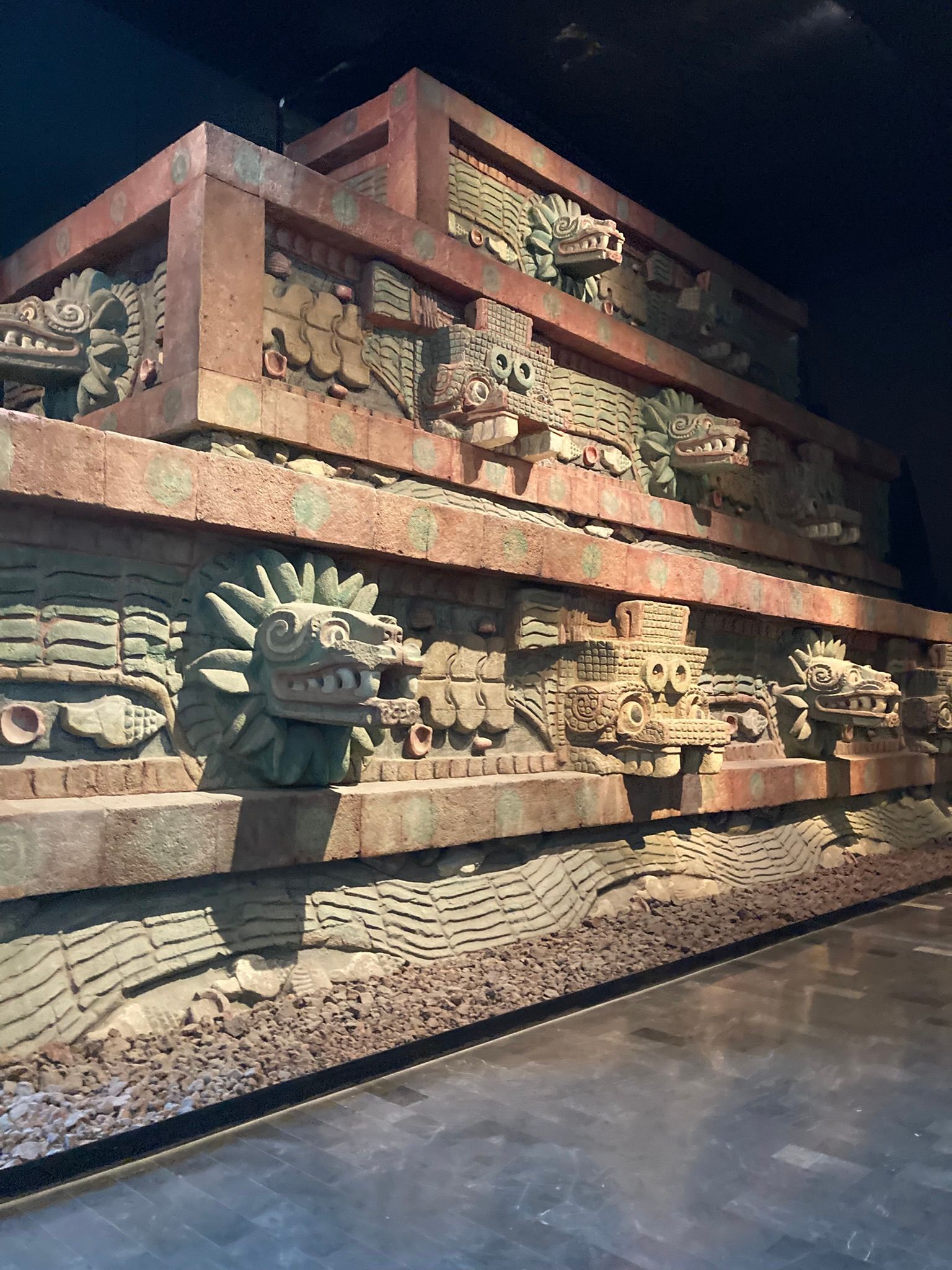
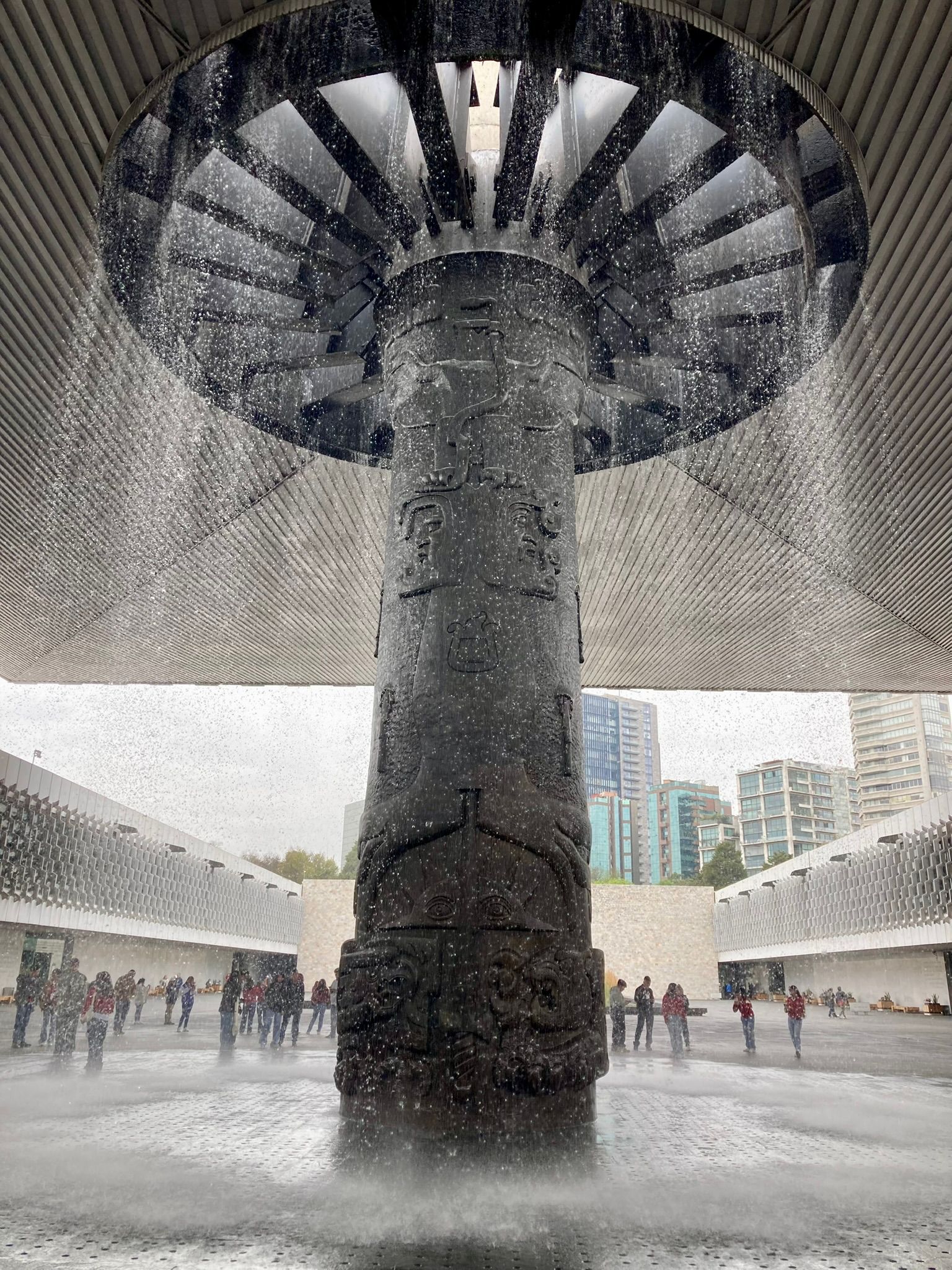
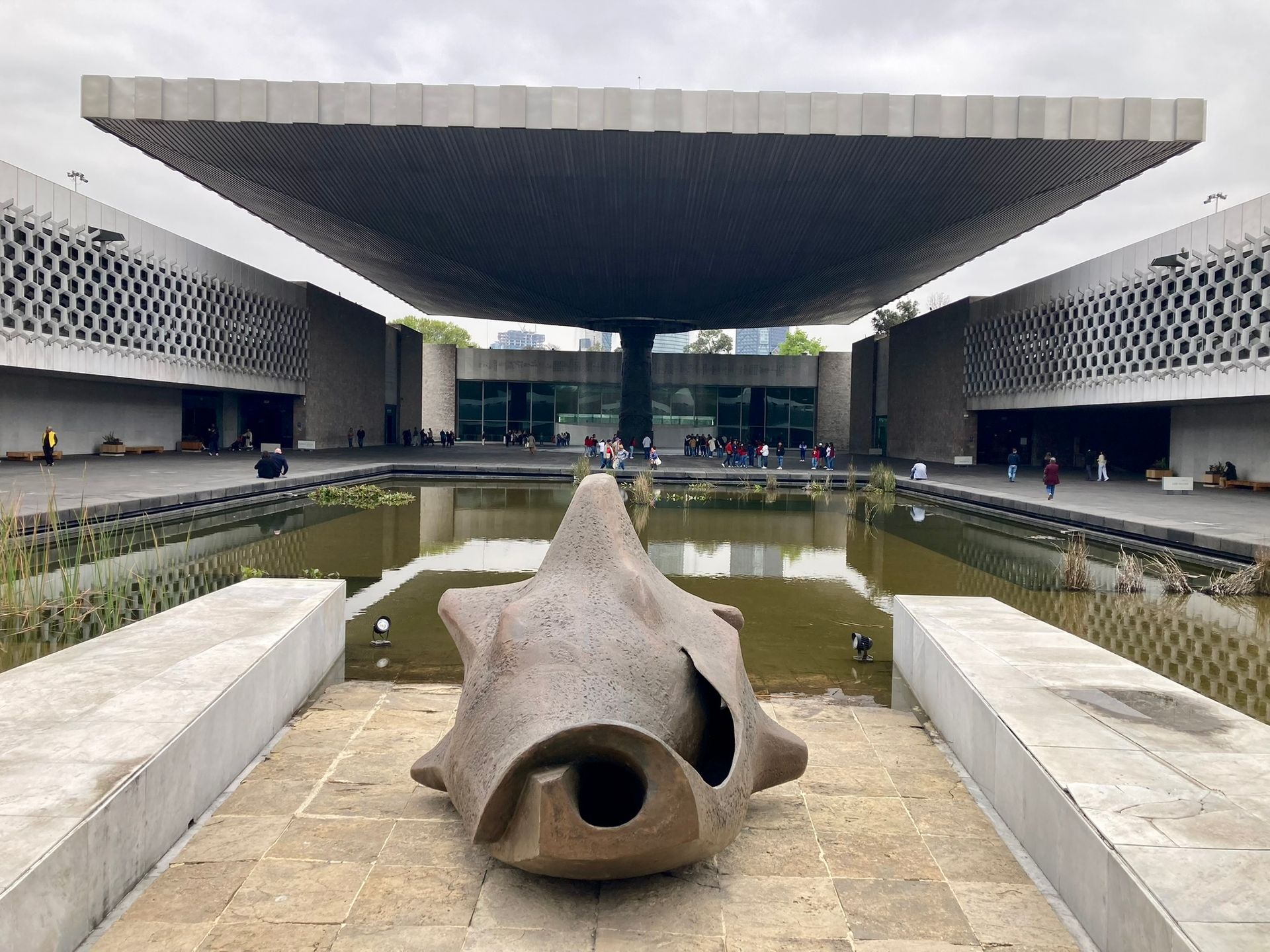
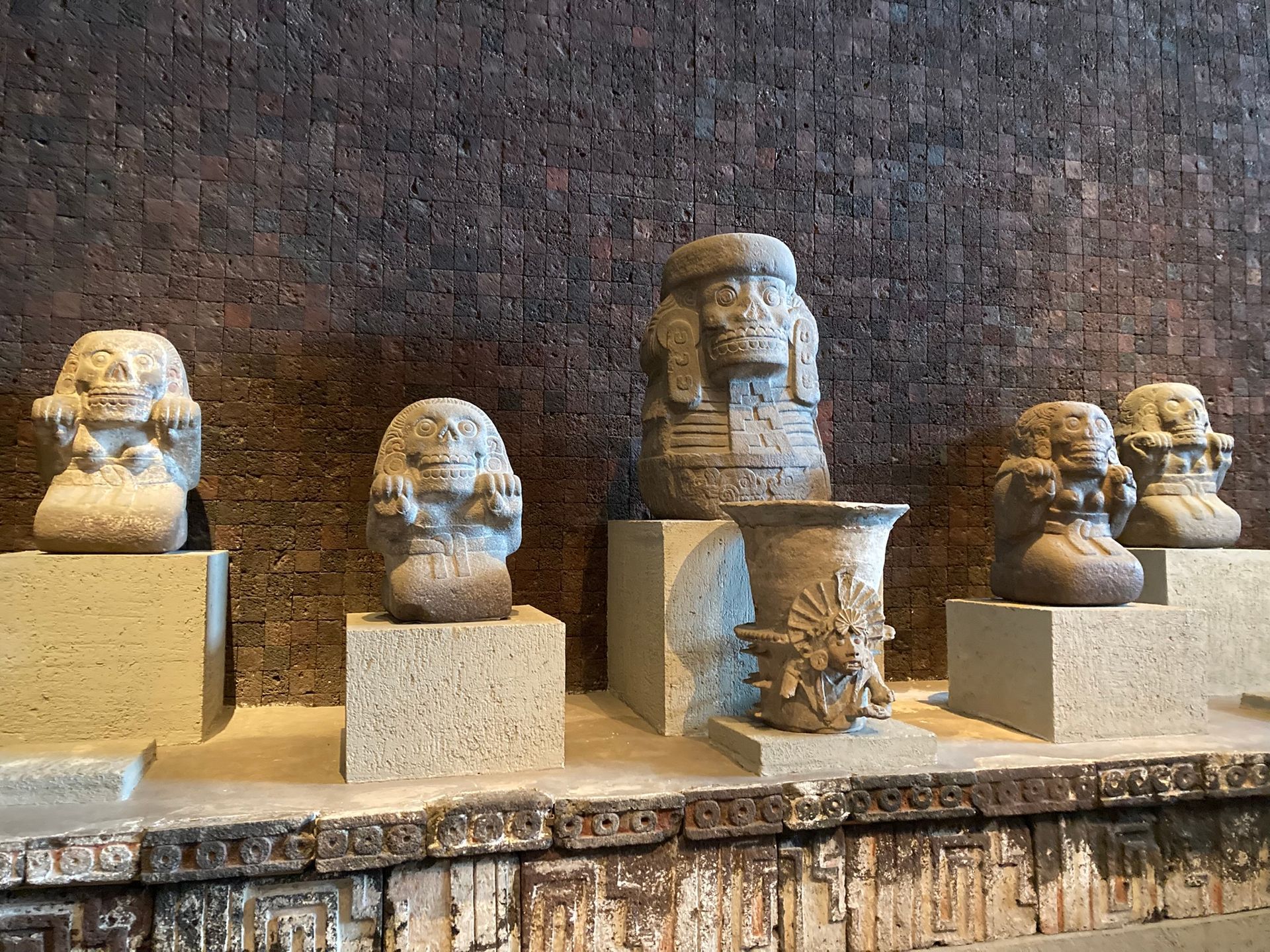
Museo Nacional de Antropología
We had a month in Mexico ahead of us — Oaxaca, Puebla, the long bus journeys between — and the Museo Nacional de Antropología was the right place to begin. We caught a bus from Alameda Park, a ten minute walk from Hotel Bellas Artes, and rode west along Paseo de la Reforma until the city loosened into trees. The Museo Nacional de Antropología sits within Chapultepec, the great green lung of Mexico City — a park so vast it contains castles, lakes, zoos, and entire museums of its own.
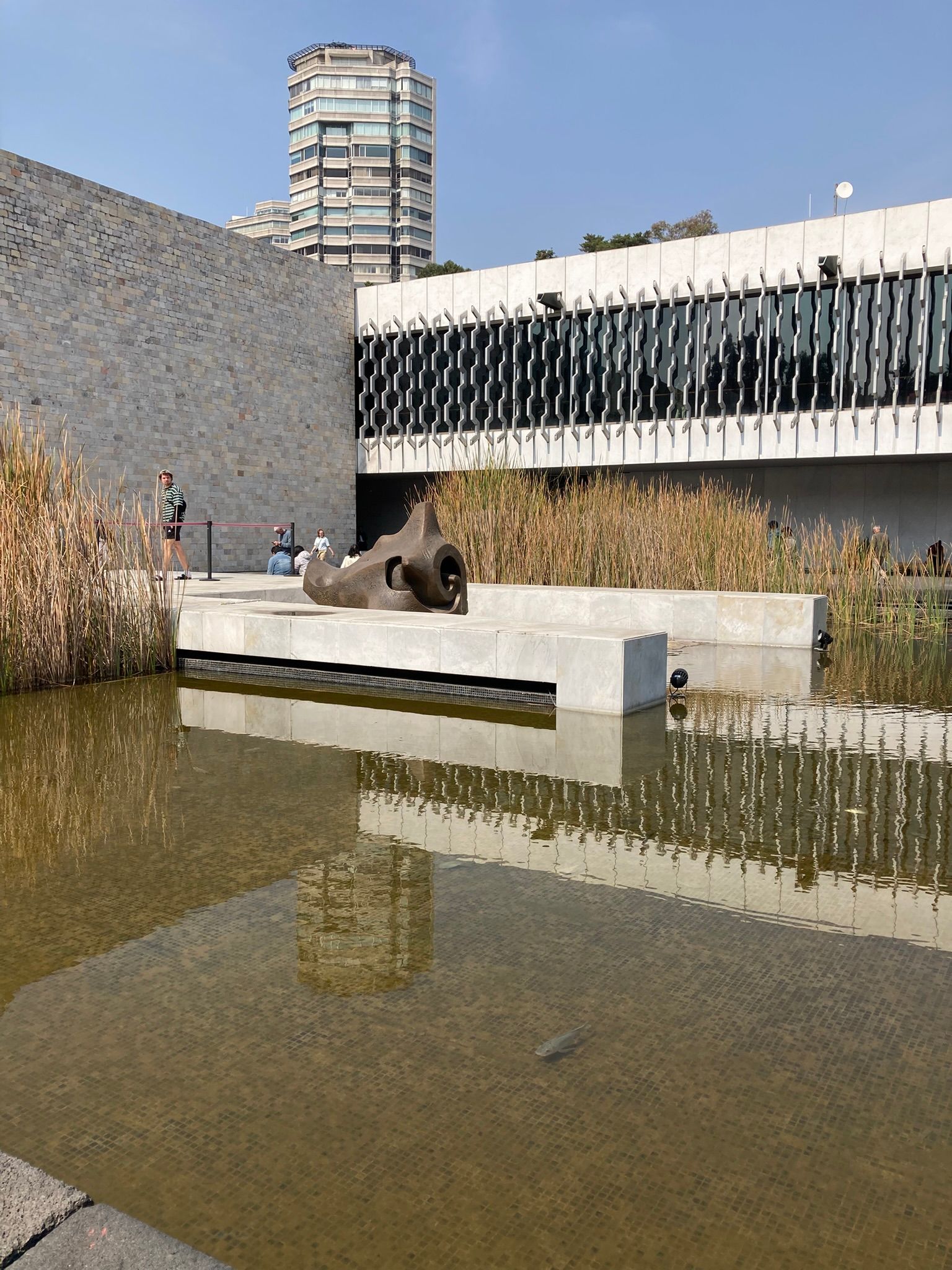
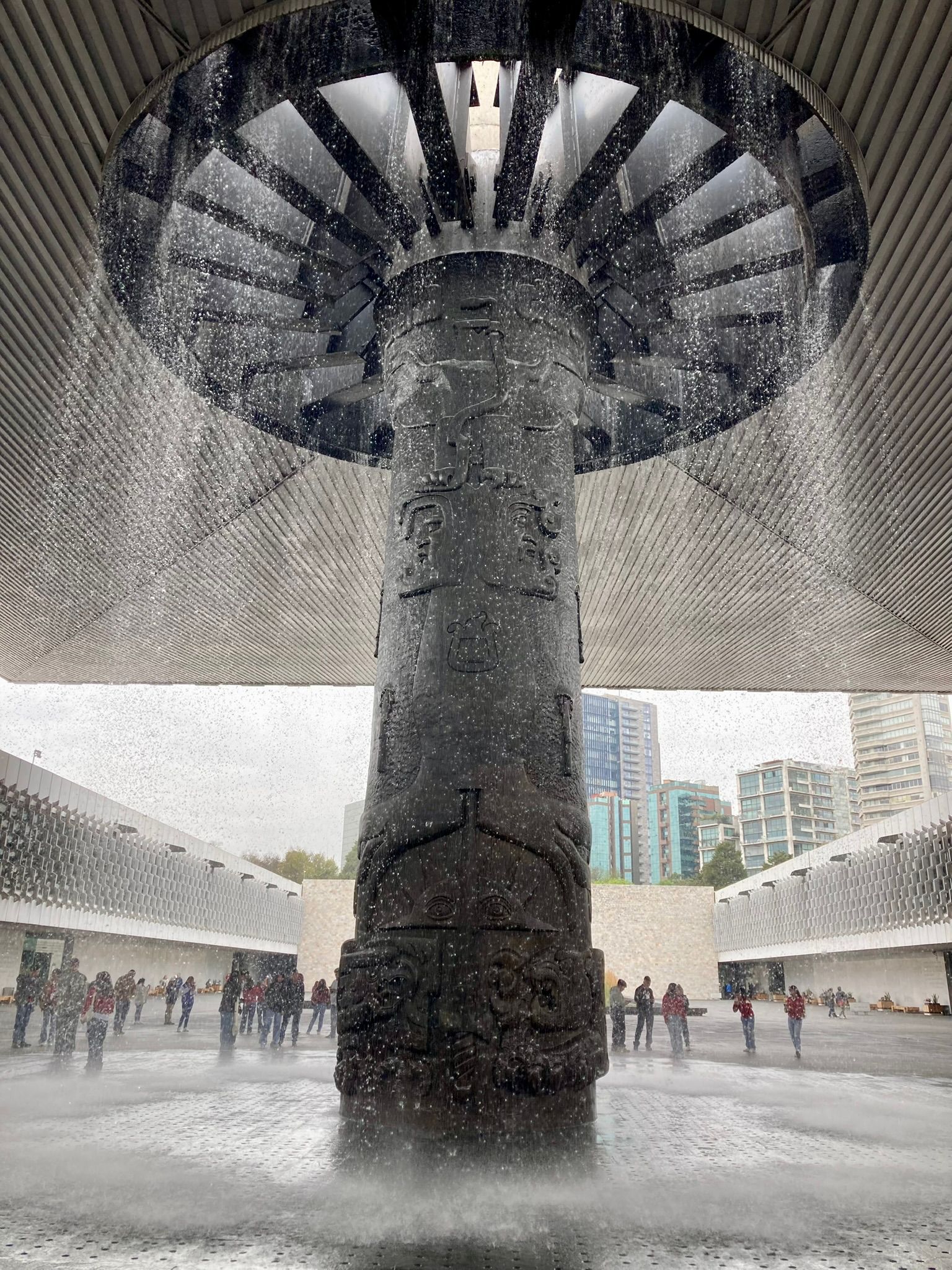
The museum opened in 1964 and was designed by Pedro Ramírez Vázquez. Its central courtyard is dominated by El Paraguas, "the umbrella" — a single vast canopy supported by one carved column, water cascading from its rim in a continuous, calming sheet. Around this open square the halls of Mexico's ancient civilisations radiate outward: Teotihuacán, Toltec, Mexica, Oaxaca, Maya, Gulf Coast, Northern, Western. Each hall is its own world. And here is the building's quiet brilliance: each indoor hall opens, at the rear, into an outdoor garden devoted to the same culture. You move from object to landscape without the walls insisting on a transition.
The Maya hall gives onto a humid garden of local plants, trees, stelae and reconstructed temples, the air thicker, the planting subtropical. The Olmec garden carries you to the Gulf Coast, the colossal stone heads more startling outside than they could ever be in a vitrine. The effect is that you begin to understand Mexico's history as many overlapping civilisations, each with its own climate, environment, culture, and stone. Different civilisations evolve in their own unique ways, fully affected by their surroundings: sea, mountains, rivers, landscape, flora and fauna.
We took our time and the museum rewards this. In the central courtyard a long, broad pond is surrounded with a stone wall, perfect for resting as the koi move slowly beneath the lily pads, indifferent to the visitors who rest here mid-circuit. We sat for a while. It is a rare thing for a major museum to provide its own reprieve, but this one does, and the pause is part of the lesson.
We did not hire a guide as we prefer ambling through a museum at our own pace, lingering where something catches our eye, though we recognise that a knowledgeable guide can add depth we might otherwise miss.
The restaurant, when we finally surrendered to it, justified the wait. The food at the Museo Nacional de Antropología is beautifully presented, and gave us the chance to order chapulines — the toasted grasshoppers of Oaxaca, served with lime and chilli. Crisp, savoury, faintly citric. We sat outside, the weather kind, the courtyard quiet, in no hurry to leave. Afterwards we slipped back into the museum for one more loop of the halls — the kind of unhurried second pass the building seems designed to invite.
It was only on leaving, later than we had intended, that we caught the voladores in full performance. Five men, in red trousers and white shirts, at the foot of a thirty-metre pole — the Voladores de Papantla, Totonac, from Veracruz, performing a ritual older than the building behind them. Four climb to the top, lean back, and fall, suspended by ropes, spiralling down in slow, widening circles while the fifth remains above, playing flute and drum. Each volador makes thirteen revolutions; multiplied by four, you arrive at fifty-two — the sacred cycle of the Mesoamerican calendar. The arithmetic of the descent is the prayer. We sat down on the low wall opposite and watched the entire ceremony from start to finish, no longer in any hurry to be anywhere else.
From there we crossed Paseo de la Reforma into the wider expanse of Chapultepec, walking past families and young couples and a steady, surreal procession of small wire monkeys — pink, blue, yellow, sunglasses on, sometimes in tiny outfits — perched cheerfully on the heads of most of the children and teenagers we passed. These, we learned, were changuitos miones: a Chapultepec phenomenon entirely. The toy monkeys are sold along the park paths by vendors, and each conceals a small mechanism in the tail that squirts a jet of water — hence the affectionately rude name (miones, from mear, to wee).
We made our way to the Lago Mayor and looked up at the Castillo de Chapultepec on its hill. The castle, we accepted, would have to wait.
We had a country to explore. We could not have asked for a better foundation. The museum had given us, in a single day, the grammar by which the rest of it might be read.