One month in Mexico
Mexico City · Oaxaca · Puebla
February 2026 – March 2026
One month across three remarkable cities. Archaeological sites and baroque churches, market stalls and fine dining restaurants, murals that argue and music that fills the streets. This is a record of what we saw, tasted, discussed and could not forget.
Day 1 — Thursday 5 February: Mexico City
The Museum of Everything, Grasshoppers at Noon, Azulejos by Night
The city begins early. From Hotel Bellas Artés we walked through the park to Hidalgo, caught the metro bus to Chapultepec, and by mid-morning were standing at the entrance to the Museo Nacional de Antropología — one of the great museums of the world.
Nothing quite prepares you for the scale of it. Room after vast room, each dedicated to a different civilisation: Olmec, Maya, Teotihuacán, Mexica, Zapotec, Mixtec. They reside in a huge rectangular modernist building, its open air courtyard presided over by an extraordinary central fountain, water cascading from a single column onto the ground below. Then further into the courtyard we were able to sit for a while on the volcanic stone surrounding the huge shallow pond, watching koi move lazily through the water.
To move through this museum is to understand what pre-Hispanic means in its fullest sense, thousands of years of complex civilisations that mapped the stars, cultivated maize and cacao, built pyramids without metal tools, and invented calendars of extraordinary precision. The art alone — stone sculpture, ceramic figures, jade masks, funerary urns — demands hours you do not have. We tried to see it all. We did not succeed. That is perhaps the only appropriate response.
For lunch we sat outside at the museum café, under the trees, and ordered with a willingness to be surprised. Chapulines — grasshoppers, boiled then fried — arrived in a taco alongside tacos al pastor and tacos con pulpo. A mezcal. A doble malta cerveza. The grasshoppers, as it turns out, taste of something between prawn and crisp; not unpleasant; rather good, in fact.
The museum's gardens extend the experience outside: more sculptures, more temples, cacti of architectural proportion, flowering against the pale stone of the building. Mexico begins its instruction immediately, and it does not pause.
From the museum we walked across to the lake in Chapultepec park, past market stalls selling everything from iced drinks to embroidered tablecloths, the herons standing in still contemplation along the water's edge. Back through Alameda park, where stallholders were packing up and a group of musicians were beginning to play — cumbia spilling out into the late afternoon air, a couple already dancing.
In the evening, Casa de Azulejos — one of Mexico City's most famous buildings, its exterior entirely clad in blue and white Talavera tiles. We ate enchiladas and mole and drank a Negra Modelo in what turned out to be their less formal restaurant; we discovered this only after, when we glimpsed the dining room, only in the next room, all white linen and low candlelight. No matter. Our waiter was the real distinction of the evening.
Tall, composed, wearing his red jacket and white shirt with the careful pride of someone who takes his profession seriously, he spoke to us for a long time in Spanish — about language, about dialect, about the differences between how people speak in Mexico City and in Oaxaca. Slower there, or faster? We would find out ourselves in a few days. He told us that somewhere in his family's history were conquistadores. He said this without apparent weight — not as pride, not as shame — simply as fact, as the layered history of this country tends to be received.
We spoke about the different languages of Spain — Catalan, Galician — and about the English north and south, and their mutual conviction that each speaks the language better than the other. The waiter smiled. He understood entirely. Mexico City, he said, had its own version of exactly this.
Day 2 — Friday 6 February: Kahlo, Trotsky, Rivera
Three Homes, Three Histories, One Blue City
The day began with minor drama. A screw protruding from a mobile food van caught my jacket and tore it cleanly. And later the light rail was running on a bus replacement service. These inconveniences were absorbed by the generosity of strangers: Mexicans stopped, redirected, advised, helped — without fuss, without hesitation.
Casa Azul, Coyoacán. The Blue House. Frida Kahlo's home for most of her life — born here, returned here, died here — is an intimate and entirely absorbing experience. Unlike many artists' homes, preserved at a careful distance behind rope and glass, this one seems still inhabited by its subject. Her bed, her mirror suspended above it (installed by her parents so she could continue painting during her long convalescences), the bespoke easel designed around the dimensions of her wheelchair, the decorative medical corsets she painted to make something decorative of necessity. The yellow kitchen, vivid and warm. The studio. The garden, with its stone mosaics and small pyramid. Her collection of pre-Hispanic figures, her books — Marx prominent among them — her photographs of Lenin, Stalin and Mao arranged at the foot of her bed: a political geography of the interior.
Not crowded because the number of visitors is limited for each session. We moved through the rooms at our own pace, which is the only pace the house permits.
Then a walk around the corner to Trotsky's house which tells its own different story — one of exile, paranoia and political murder — yet it felt, paradoxically, more domestic. The rabbit hutches in the garden. The open icebox. The books in multiple languages. The bricked-up window. The thick internal doors, built like bank vaults after the first assassination attempt, when David Alfaro Siqueiros — of all people, a fellow muralist, Diego Rivera's comrade — arrived with twenty men in military uniforms and machine-gunned the bedroom. Trotsky and his wife heard them coming and rolled beneath the bed. The gunmen assumed success and left. They were wrong.
Ramón Mercader was not so careless. A Spaniard who had fought in the Civil War, directed by Stalin's intelligence service, he earned Trotsky's trust over months before driving an ice axe into his skull in this house on 20 August 1940. The watch tower over the garden still stands. The bullet holes in the bedroom wall are still there. The study where Trotsky was killed is preserved exactly: books, papers, a pen.
Our third destination — and perhaps the most unexpected — was the Museo Anahuacalli, Diego Rivera's self-designed pyramid on the edge of the city. Built from volcanic stone, its long narrow windows admitting shafts of dark light, it sits on the landscape like something between a folly and a temple. Rivera called it his 'gift to the Mexican people', and inside he housed his collection of pre-Hispanic clay artefacts — some 59,000 in total, of which around 2,000 are on display. Miniature figures, animals, toys; ceramic gods and funerary vessels arranged on shelves that climb the stone walls. The roof terrace offers extraordinary views: mountains, volcanoes, trees, the vast, hazy city below.
In the evening, La Ópera — one of the oldest and grandest restaurants in Mexico City, its interior all carved wood, gilt mirrors and the particular darkness of rooms that have been taking themselves seriously since the nineteenth century. Food and atmosphere in full agreement with each other.
Day 3 — Saturday 7 February: The Zócalo and Its Depths
Templo Mayor, Conquest, the Cathedral, and the City Beneath the City
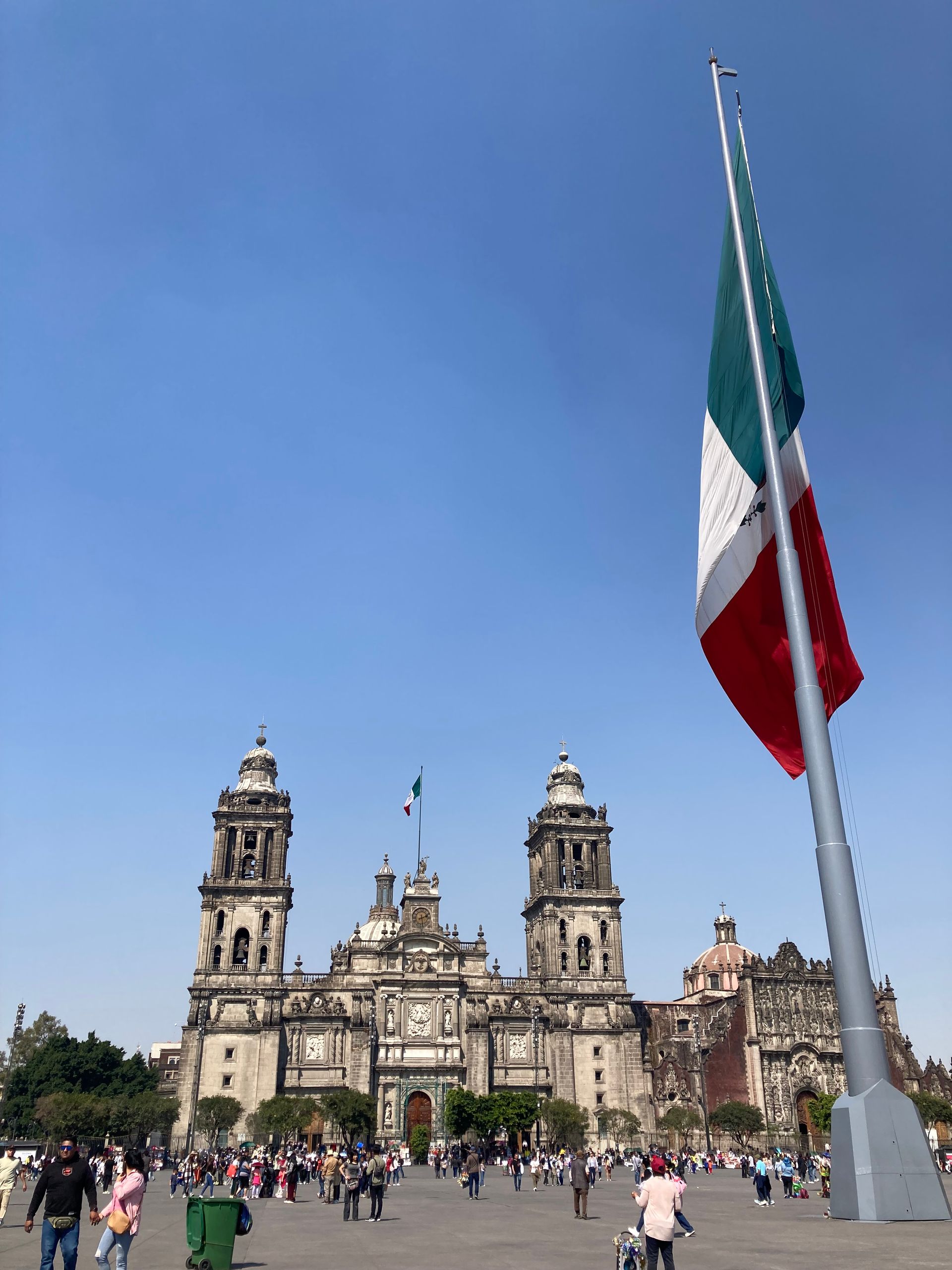
The Zócalo is the largest city square in the Americas, and standing at its centre — flag the size of a house snapping in the wind above you, the Metropolitan Cathedral immovable on one side, the Palacio Nacional on another — you feel the full weight of Mexican history pressing upward through the ground beneath your feet.
Quite literally. Because beneath this square, beneath colonial streets and foundations laid four centuries ago, lies Tenochtitlán — the great Aztec capital, built on an island in Lake Texcoco in 1325, dismantled by the Spanish after 1521 and buried under the city they constructed in its place.
The Templo Mayor, the ceremonial heart of that world, was not rediscovered until 1978, when electricity workers found the Coyolxauhqui stone — a vast circular disc carved with the dismembered goddess — while laying cables near the Zócalo. What followed was one of the most significant archaeological excavations of the twentieth century: still ongoing, still revealing.
What makes the Templo Mayor so arresting is not just its scale, though the scale is considerable. It is the accumulation of time within it. Seven successive rebuildings, each new ruler encasing the previous temple within a larger one, so the structure grew with the empire. The carved eagles and frogs and undulating serpents that line the ceremonial banquettes were not decorative — they were cosmological. Eagle: the sun, warriors, sacrifice. Frog: rain, fertility, water. Serpent: earth, cycles, renewal. The temple was understood as the axis of the world.
And then the Huey Tzompantli — the skull rack, recently excavated — which confirmed what Spanish accounts had described and scholars had doubted: a vast structure composed of human skulls, testament to the scale and centrality of ritual sacrifice in Aztec life. Not peripheral. Not exceptional. Woven into the cosmological fabric of the city.
In 1790, workers paving streets near the Zócalo unearthed the Aztec Sun Stone and the enormous statue of Coatlicue. Both were briefly studied; Coatlicue was reburied as too disturbing. The Spanish had dismantled the Templo Mayor in 1521, using its stones to build the Cathedral that now stands directly beside it — an act of deliberate spiritual overwriting. It took another two centuries after those early discoveries for systematic excavation to begin.
The museum entrance allows for an expansive walk through the huge temple remains, a look at the finds and clear explanations of these.
In the afternoon, San Ildefonso — cultural centre, exhibitions, acting performances in the courtyards — and then the Secretaría de Educación Pública, where Rivera's murals speak at full volume across more than two hundred panels on three floors. A visual novel of Mexican history, labour, politics and identity: miners descending into what he painted as the mouth of a beast, arms outstretched in accidental crucifixion; weavers bent over their looms in meditative concentration; at the top, the billionaires' banquet, Rockefeller and Ford dining on gold coins while a watchful worker stands behind them. In the stairwell, the nation rises from tropical coast to volcanic plateau, and on the wall, Frida Kahlo distributes rifles from the arsenal with a steady, committed gaze.
We ended the day where we had begun it, almost — dinner and beer at Casa de Azulejos, its tiles catching the last of the afternoon light, the enchiladas arriving exactly as hoped.
Day 4 — Sunday 8 February: Ballet Folklórico, Bellas Artes, an Earthquake
Sequins, Murals, and a Siren in the Cathedral
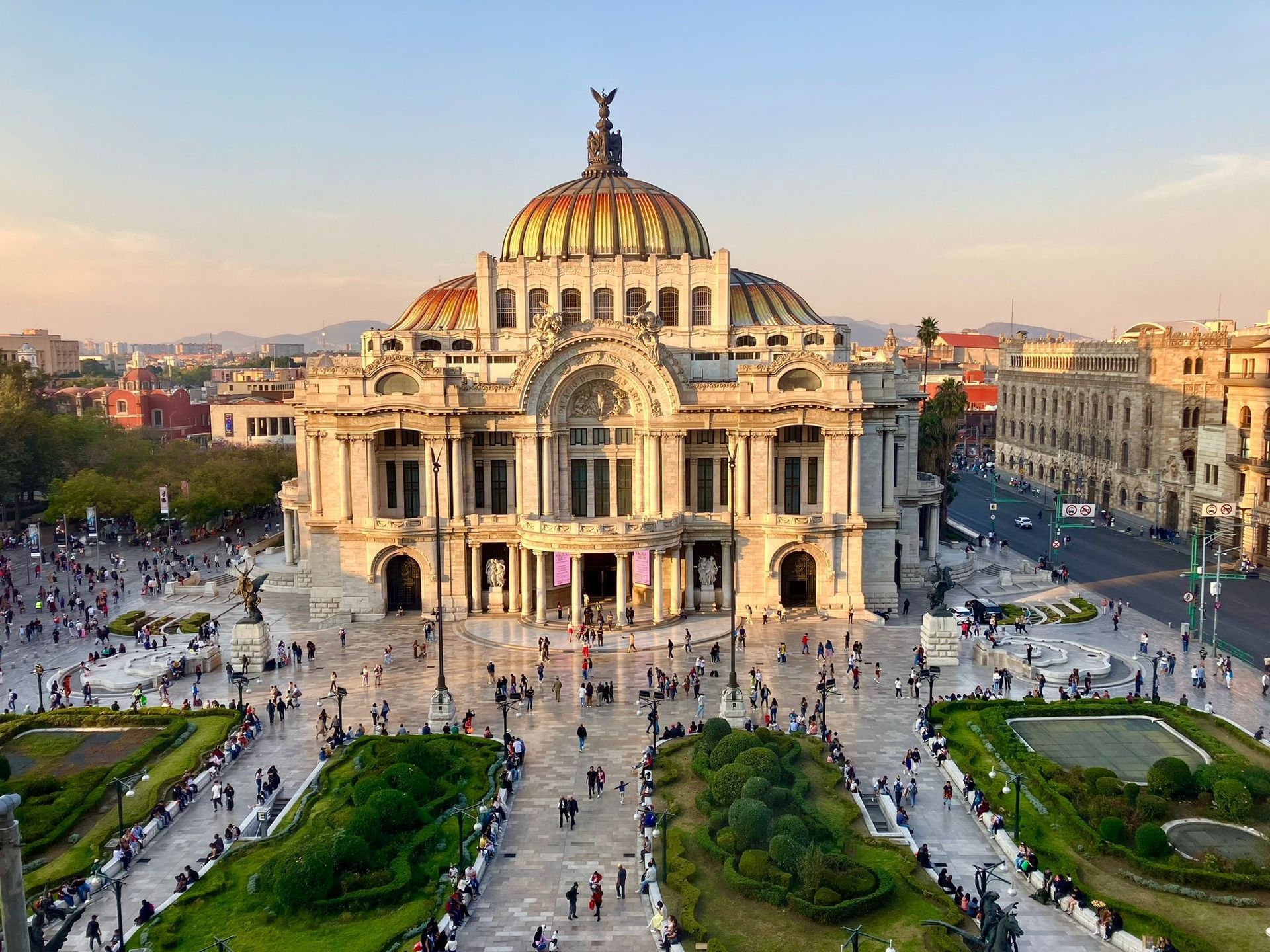
Founded by Amalia Hernández in 1952 with eight dancers, the Ballet Folklórico de México now puts fifty people on a stage that already qualifies as one of the most beautiful rooms in the country. The Palacio de Bellas Artes is Art Nouveau and Art Deco in spectacular combination, its curtain a Tiffany-glass recreation of the volcanoes — Popocatépetl and Iztaccíhuatl — illuminated from behind in shifting colours, the acoustics of a concert hall built for exactly this kind of performance.
I loved it unreservedly. The dancing, the singing, the costumes — particularly the women in their enormous skirts, sixteen dancers in yellow and pink performing La Sandunga with flowers balanced on their heads as they moved. A man in orange and purple competing for a woman's attention, losing, shooting them. Female charras on horseback. A blue skeleton whose legs kicked up to her ears with a rattling of bones. Two mariachi harpists in elegant competition, fingers racing over strings. The devil sweeping things under a carpet. A lasso man who eventually caught his love.
La Cucaracha arrived like a surprise, and the whole theatre seemed to exhale with pleasure. Viva México.
This is not folk dancing reduced to spectacle for tourists. It is Mexico performing its own pride to itself — with an army of musicians, singers whose voices could fill an opera house, and a production budget that makes no apologies. The singing was as good as any opera I have heard.
We only paid for the Gallery tickets at the Palacio, which we were very happy with.
Afterwards, coffee in the Palacio Bellas Artes café, then upstairs to the murals. Diego Rivera's Man at the Crossroads — a recreation of the mural destroyed in New York's Rockefeller Center when Nelson Rockefeller objected to Lenin's face — presents humanity at a fork: capitalism in one direction, socialism in the other, a worker at the controls. Rivera paints revolution as something comprehensible, grounded in recognisable faces and shared histories.
David Alfaro Siqueiros answers differently. His New Democracy across the opposite wall is a physical assault: foreshortened bodies erupting toward you, a wounded figure breaking from chains, industrial paint applied with the urgency of someone who believes art is not sufficient unless it disturbs. Where Rivera explains, Siqueiros confronts. Together in this space — the most elegant cultural building in Mexico — they make the point without needing to state it: art and politics are inseparable here.
Later that day we walked to the Zocalo and visited the Metropolitan Cathedral for a late afternoon service. The singing drew us in. We found seats and listened. Then the earthquake siren sounded — low, persistent, unmistakable — and the entire congregation rose calmly and moved toward the exits in practiced, unhurried order.
A father and son in the Zocalo, seeing my uncertainty, came across to explain, nothing to panic about, the most important action is calm. I was a little shaken.
The evening dissolved into the streets around the Bellas Artes park — a barrel organ player in green uniform producing something between music and melancholy; then a wander returning closer to the Zocalo and a taco restaurant with white walls, red writing and a sawdusted floor. Taco quotes covering the walls such as ‘A balanced diet is a taco in both hands.’
Day 5 — Monday 9 February: The Bus to Oaxaca
Volcanoes, Cactus Fields, and a Different Kind of City
An Uber at 6.15am to Mexico Norte, the vast bus station that operates like a small airport — gates for specific carriers, announcements, a general atmosphere of early-morning organised departure. We were travelling ADO Executive Class to Oaxaca: reclining seats, individual screens, a bottle of water. The bus was full and on time.
We left the city as the sun was still low, and within an hour the landscape had changed entirely. Popocatépetl drifted past the window, smoking gently — a detail that never stops being remarkable, the active volcano as a casual backdrop. Then came the fields: first hundreds of hectares of cactus, then cactus covering whole hillsides, then mountains dense with it. The varieties multiplied as we went south. Closer to Oaxaca, the cactus gave way to trees, the air visibly changed, and the altitude made itself felt in the quality of the light.
Oaxaca is further south than I had properly considered. You feel the latitude in the warmth, in the vegetation, in the pace of things.
Our apartment at the Hotel Parador de Santo Domingo de Guzmán was basic but superbly located in the historic centre. In the afternoon we found our bearings: provisions for breakfast from the market — oats, nuts, fresh and dried fruit — milk and washing liquid from the local Pitico supermarket, a chain we would come to know well. We ate mole in the Mercado 20 de Noviembre. Two small chicken drumsticks alongside it. Simple, right, remarkably good value.
The Zócalo in the evening: entirely alive. Restaurants and bars surrounding the square on all sides, people at every table, families on the cathedral steps. In the centre of the square, a band was performing — a full band, including six men playing the xylophone simultaneously, their mallets a blur. The cathedral glowed. Oaxaca announced itself.
Mexico City had felt like a capital: immense, complex, historically layered, demanding. Oaxaca felt immediately like somewhere you might stay for a while and begin to understand. The streets were cleaner. The shops were different. The proportion was human.
Day 6 — Tuesday 10 February: Santo Domingo, the Botanical Garden, and a Last-Minute Dinner
Gold Leaf, Dice Theology, and a Fortuitous Wrong Turn
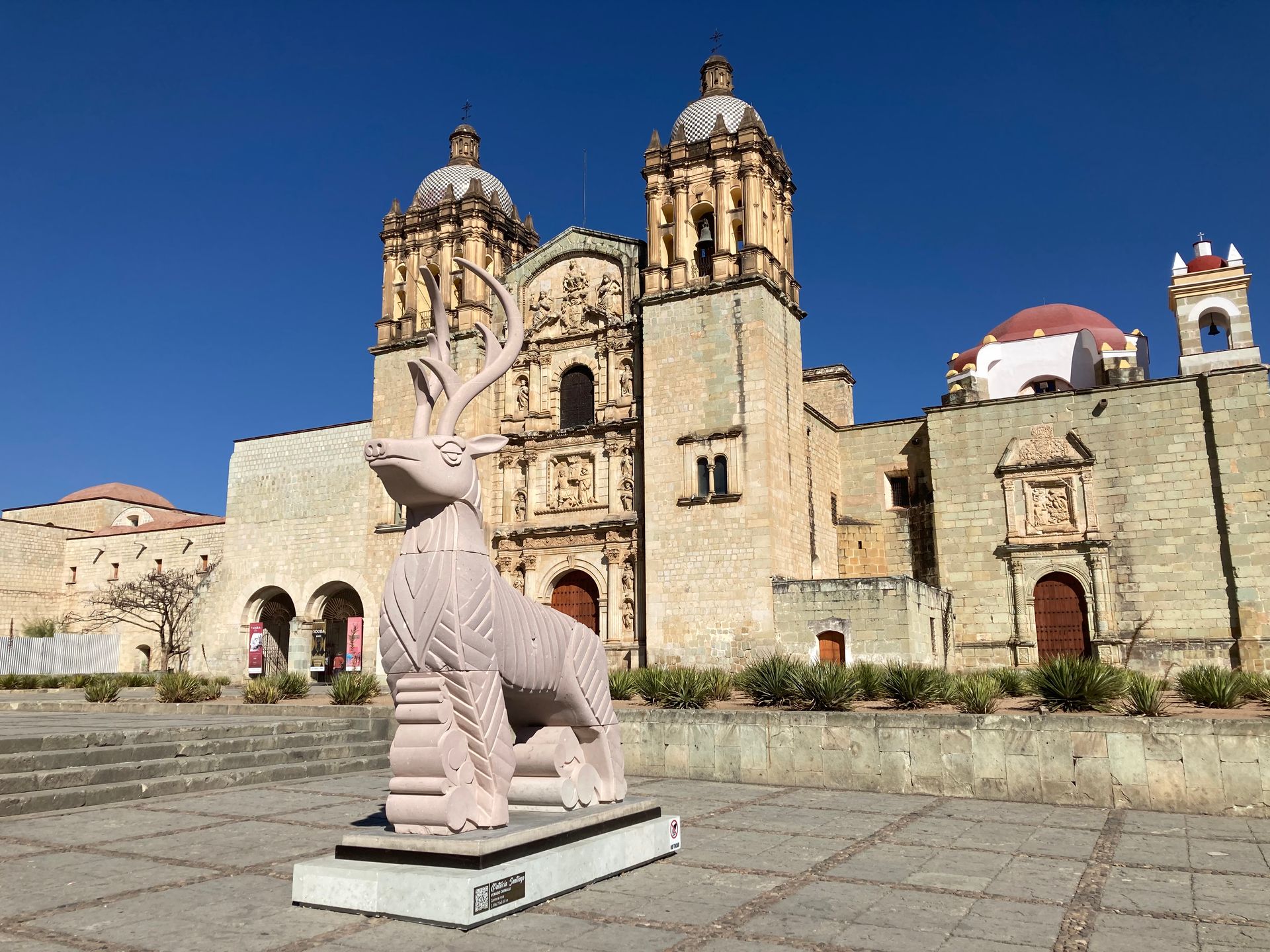
A morning of laundry, which is to say: a morning by the pool, reading, letting the sun do its work. Then out to the Templo de Santo Domingo de Guzmán, one of the supreme achievements of Mexican Baroque architecture.
The Dominicans began building here in the late sixteenth century and spent the seventeenth completing it. The result is a gilded interior of overwhelming ambition — designed not simply to impress but to instruct, to overwhelm, to make the divine tangible through the accumulation of gold leaf and carved stone and painted ceiling and the particular quality of light that Baroque churches manufacture. After the Reform Laws of the nineteenth century secularised the Church's property, this building became military barracks. Horses were stabled where friars had prayed. It is restored now, and the contrast between that history and the present serenity of the space gives it an additional weight.
In one of the side chapels, dice showing seven. I spent a while thinking about this. The Church's number of completeness: seven days of creation, seven sacraments, seven virtues. Dice: the Roman soldiers casting lots at the crucifixion, but also the randomness of earthly life, the moral gamble. Fix the dice to seven and you have a visual sermon in miniature — Baroque theology done with gambling equipment. It is exactly the tradition: playful, didactic, slightly unsettling.
In the same complex, the remarkable Museo de las Culturas de Oaxaca, housed in the former monastery cloisters. Stone Age tools through to colonial conquest and beyond — Zapotec and Mixtec civilisations, Spanish imposition, religious art that shows the two worlds colliding and slowly, uneasily intertwining. The building itself is among the finest artefacts on display.
We tried to visit the botanical garden behind the Templo — some of the finest cacti in Mexico in a setting of exceptional beauty — but tours were limited and we resolved to return the following day.
In the evening I had chosen a restaurant. It was full. We doubled back through the cobbled streets, slightly at a loss, and ended up at Totopo Güero Cocina Istmeña — food from the Isthmus of Tehuantepec, the narrow southern corridor of Mexico between the Pacific and the Gulf. What followed was one of the best meals of the trip: flavours unfamiliar even within the context of Oaxacan cooking, the kitchen of a specific place rather than a generalised region. Fortuitous wrong turns remain among travel's reliable pleasures.
Day 7 — Wednesday 11 February: Cacti, a Kiskadee, and Xochimilco
The Botanical Garden, Street Art, and an Eighteenth-Century Aqueduct
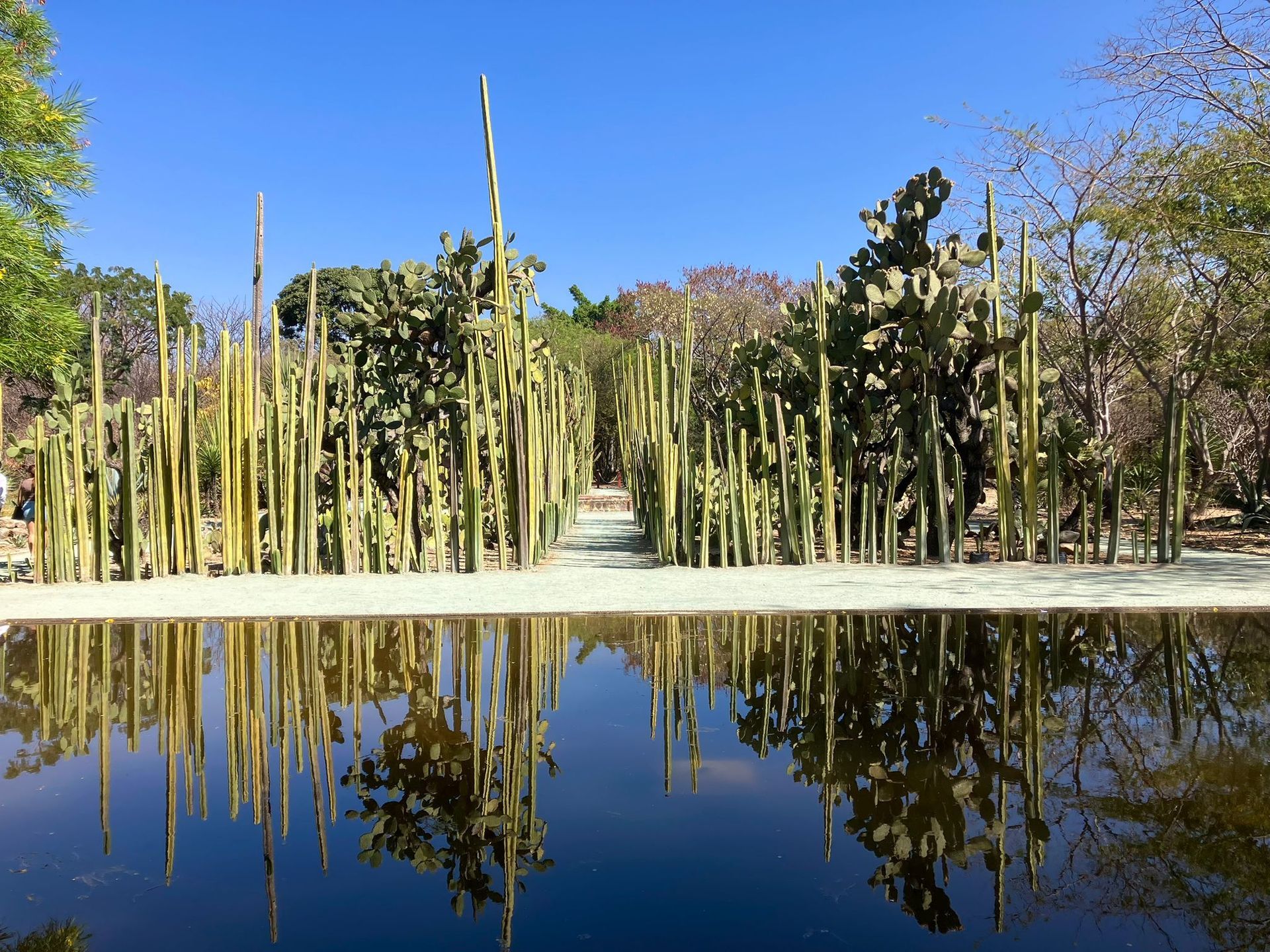
The botanical garden at last. Twenty minutes, guided — the only way to visit, for reasons that were not explained to us but may have to do with conservation, crowd management, or the particular temperament of the institution. No matter: twenty minutes was enough to see hundreds of cacti in extraordinary variety, some reaching five or six metres, others flowering in defiance of expectation, the whole collection arranged with curatorial intelligence against a backdrop of old monastery walls.
A kiskadee appeared in one of the small trees — the great kiskadee, to be precise: bold yellow belly, black and white head, rufous wings, boisterous and conspicuous in the way that only birds entirely confident in their territory can be. It called once, loudly, and flew.
After an afternoon of sun and reading by the pool — necessary, both — we went up to Xochimilco, the barrio north of the centre. The name is older than the Spanish city: Nahuatl, meaning 'flower gardens', the same name as the famous floating gardens district of Mexico City. In Oaxaca, it is a neighbourhood of cobbled streets, painted walls and an outdoor gallery culture that seems to have grown organically from the community rather than being applied to it.
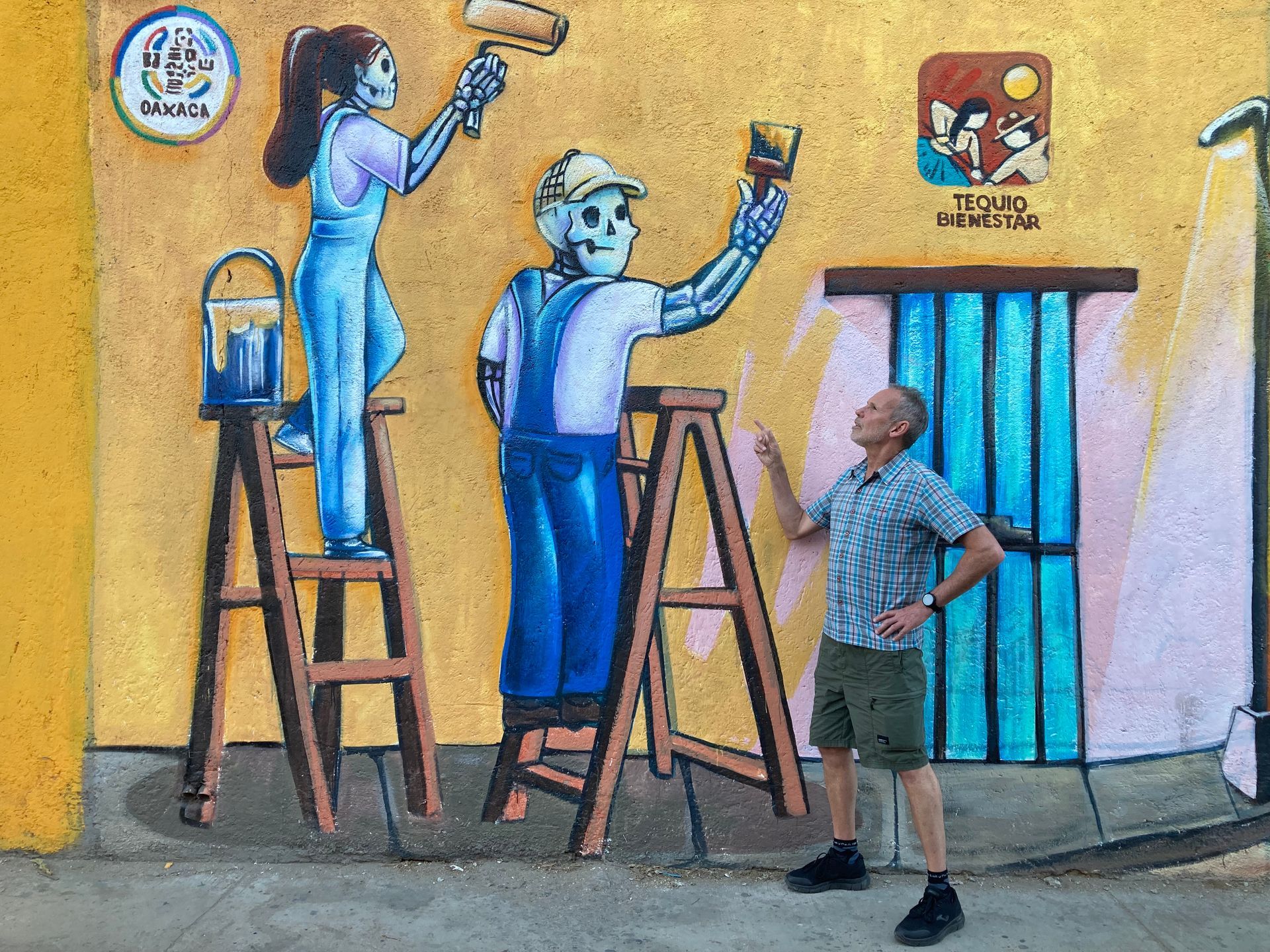
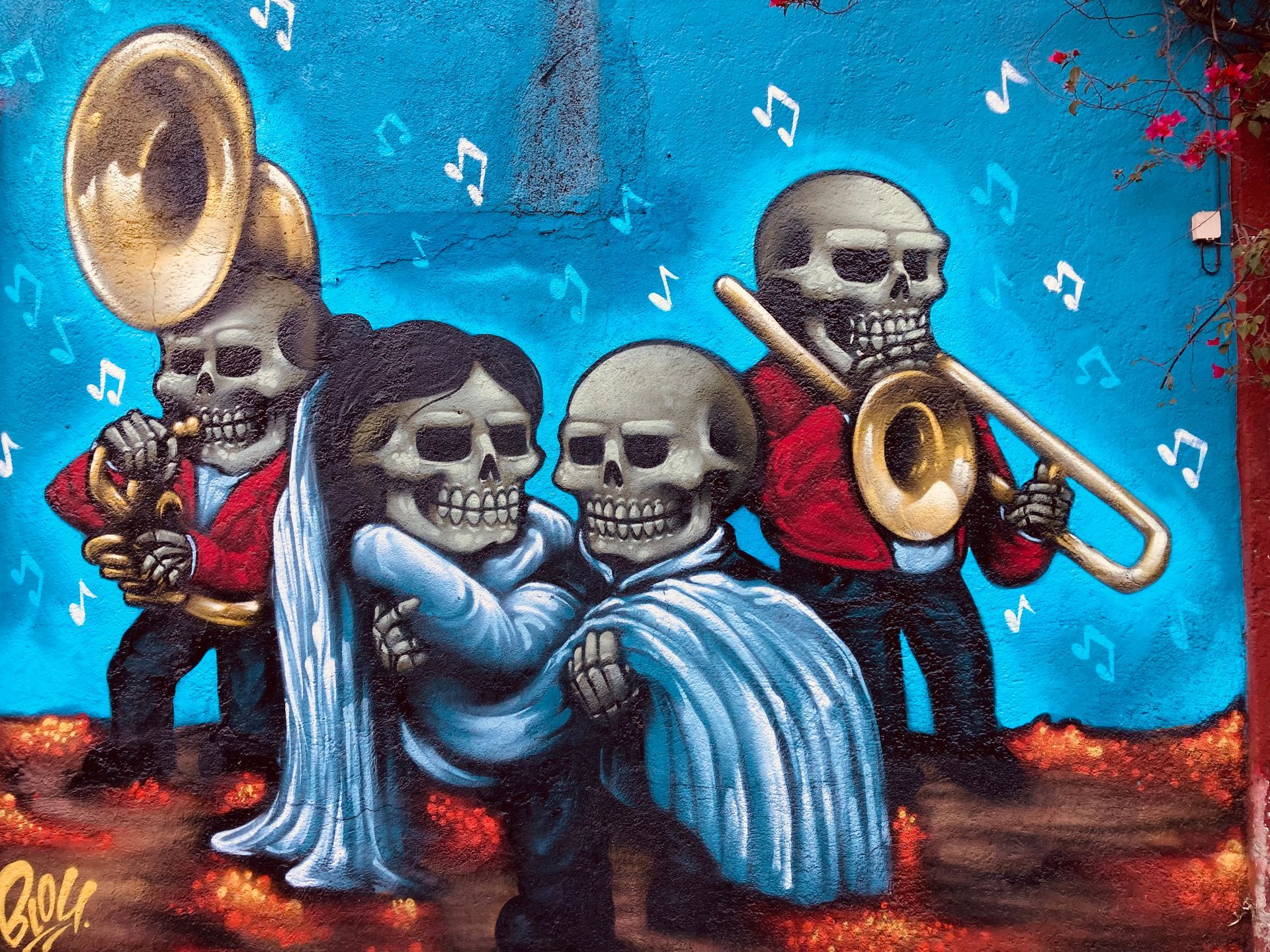
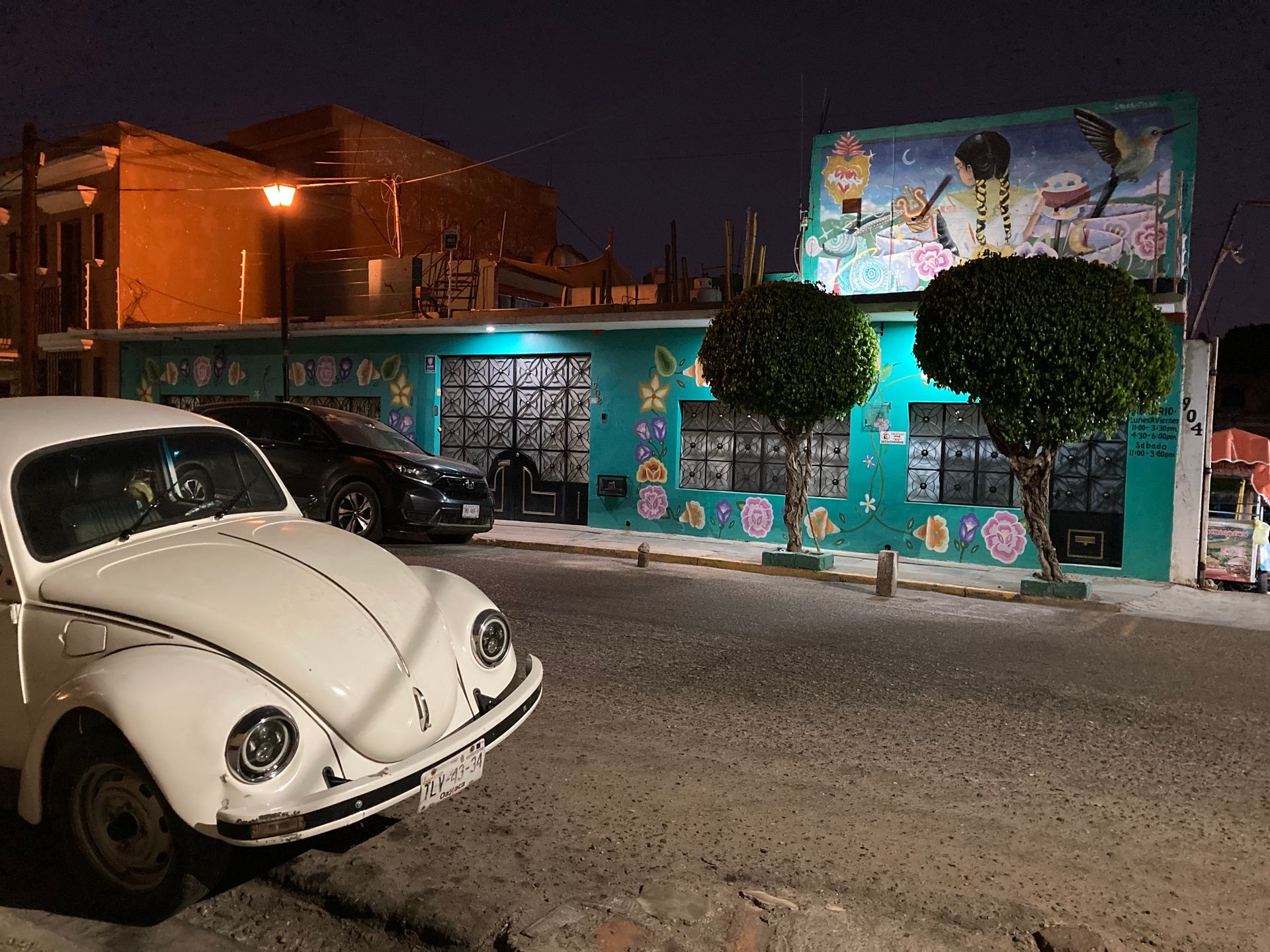
Street art here is not graffiti. It is narrative: bold murals depicting Oaxacan identity, Tehuana women, historical scenes, abstract forms. You turn a corner and find yourself in front of something that has clearly taken weeks to complete. There is no ticket, no audio guide. You simply walk.
The Aqueduct of San Felipe — the Arquitos de Xochimilco — ran through part of our walk: a surviving section of eighteenth-century infrastructure, graceful arches in green cantera stone, built to carry spring water from the hills into the city below. It worked by gravity alone. Today it carries nothing but its own history, and a certain elegance in the afternoon light.
Our meal was crispy tlayudas at a local bar, accompanied by corona and negro modelo beers.
Day 8 — Thursday 12 February: Monte Albán and Jalatlaco
A Flattened Mountain, Tomb 7, and a Neighbourhood of Murals
The easiest way to reach Monte Albán is by shuttle from the centre, and we booked ours directly with Lescas Tours at their office facing the Cathedral behind the clothes stalls. This was straightforward, inexpensive, with a departure at 8.30am, return at noon. Go early. The heat by midday is substantial, and the site demands walking. We do not tend to book Tour Guides, I read up beforehand as much as I can.
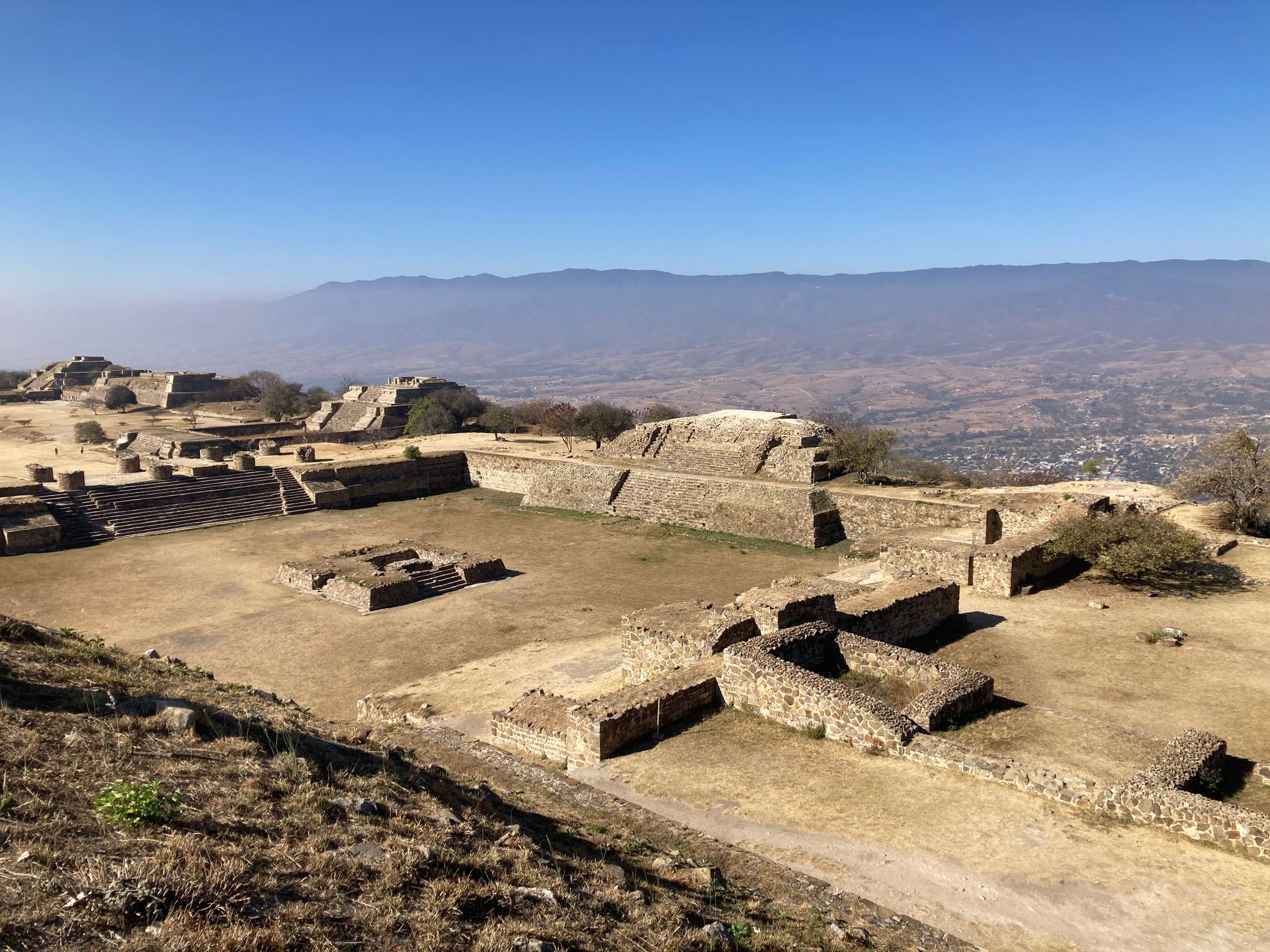
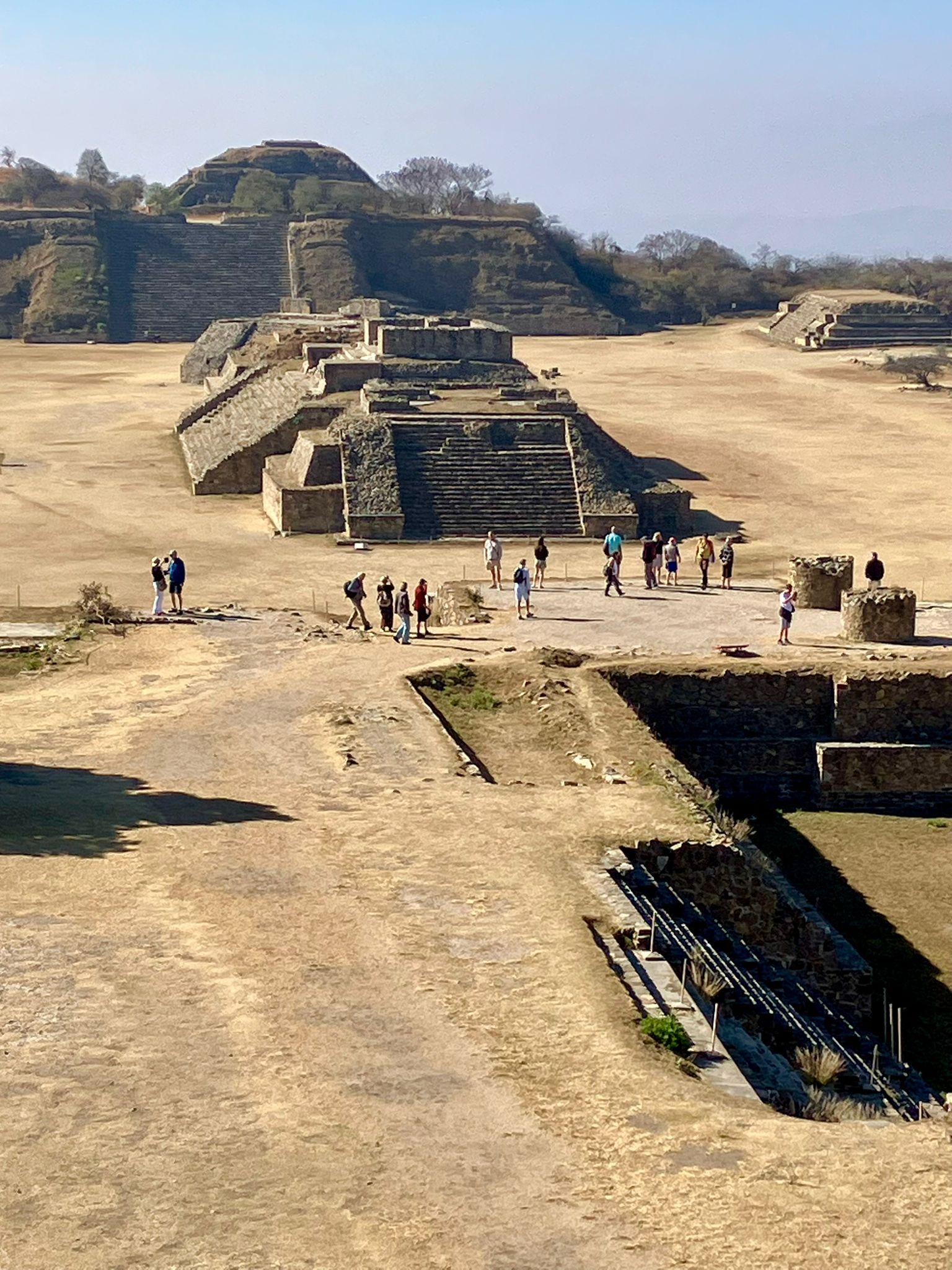
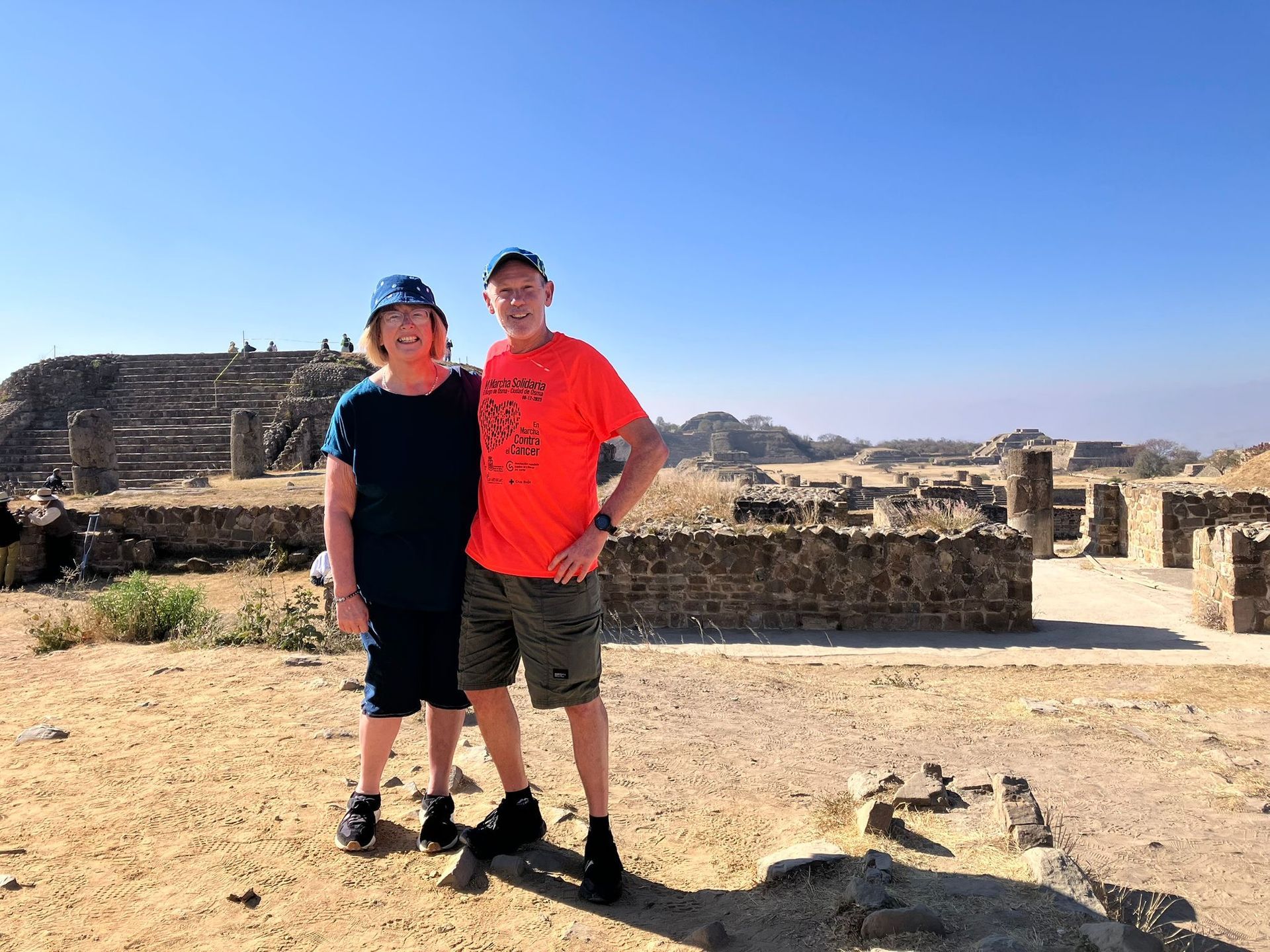
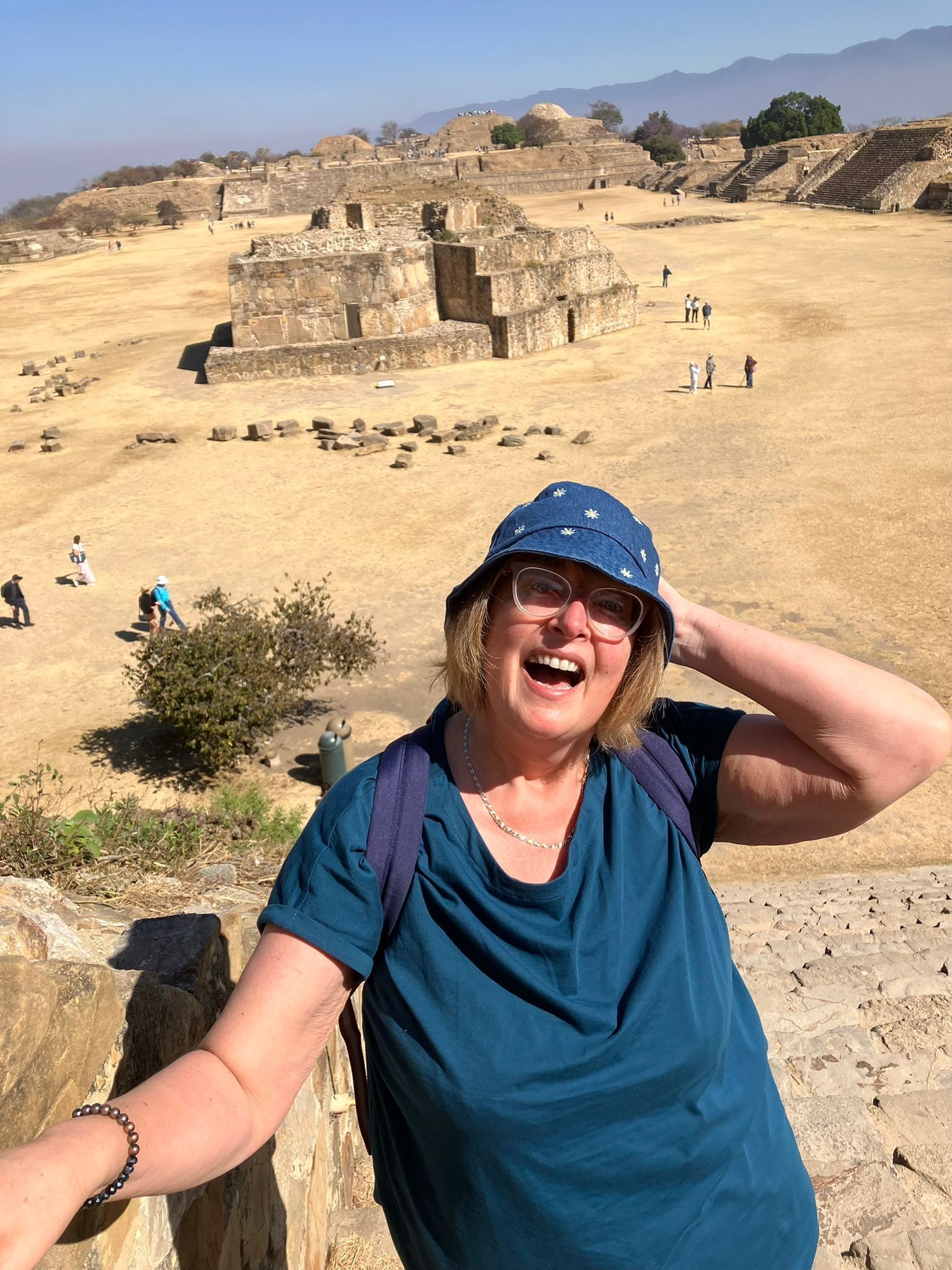
Monte Albán is breathtaking in the precise, literal sense: you see it and something in your chest tightens. Founded by the Zapotecs around 500 BC, this city was built on a mountain that was first flattened — manually, without metal tools or machinery or draft animals — and then shaped into a ceremonial plaza of staggering scale. Standing at the centre of the Gran Plaza, you understand in your body rather than your mind what it required. The summit of a mountain, reshaped by human labour alone.
We climbed the pyramids slowly, pausing to breathe and to look. From the top, the three valleys open in all directions toward modern Oaxaca, which appears small and recent from this height. The Zapotecs chose this position for exactly the reasons you would choose it: commanding, symbolic, theatrical in its relationship to the landscape.
The carved stone figures known as Los Danzantes — once interpreted as dancers, now generally understood as depicting captives, some shown in positions associated with sacrifice or death — line up against one of the walls. The information boards around the site are clear and generous; we were grateful for them.
In the small trees near one of the platforms, a bird: tiny, black, with a startlingly red face. A red-faced warbler, far from its usual territory, catching the light in the branches.
We visited Tomb 56, one of several accessible to visitors. Stepping down into the cool, stone-lined chamber creates an immediate sense of trespass on something private — these spaces were sealed for eternity, not designed for the gaze of strangers. The tombs are empty now; their contents are in museums. But knowing what was found here changes what you see. The Zapotec built their sacred spaces for the dead as carefully as those for the living.
Having visited the Museo Nacional de Antropología in Mexico City, where the treasures from Tomb 7 — gold pectorals, jade ornaments, turquoise mosaics, the famous skull overlaid with turquoise tesserae — are displayed, we stood inside these chambers able to picture them furnished. That sequence of museum then site is, if possible, the right order.
Before leaving we visited the small, well laid out, Monte Alban museum, and had a coffee at the small café with its view over the slopes toward Oaxaca, then back on the shuttle and out.
In the afternoon, we walked to Jalatlaco: another neighbourhood of murals. Cobblestones, adobe walls painted in burnt orange and terracotta and ochre, and on every corner something worth stopping to photograph. Catrinas, Tehuana women, scenes from Oaxacan cultural life — all executed with the confidence of artists who know their subject. Jalatlaco is not curated. It has simply grown this way.
Day 9 — Friday 13 February: Carnival, Casa Oaxaca
Chocolate con Agua, a Fiesta, and a World-Class Dinner
A morning walk to the Espacio Zapata area — more murals, different in character from Jalatlaco, less densely concentrated, interspersed with small galleries and shops selling ceramics and textiles. We browsed more than we bought, which in Oaxaca takes some discipline.
At Mercado Sánchez Pascuas nearby we stopped for chocolate con agua — Oaxacan drinking chocolate made with water rather than milk, as it has been for centuries, dark and slightly grainy in the way that pre-Columbian cacao preparations were. It is less sweet than the European version, more complex, more itself.
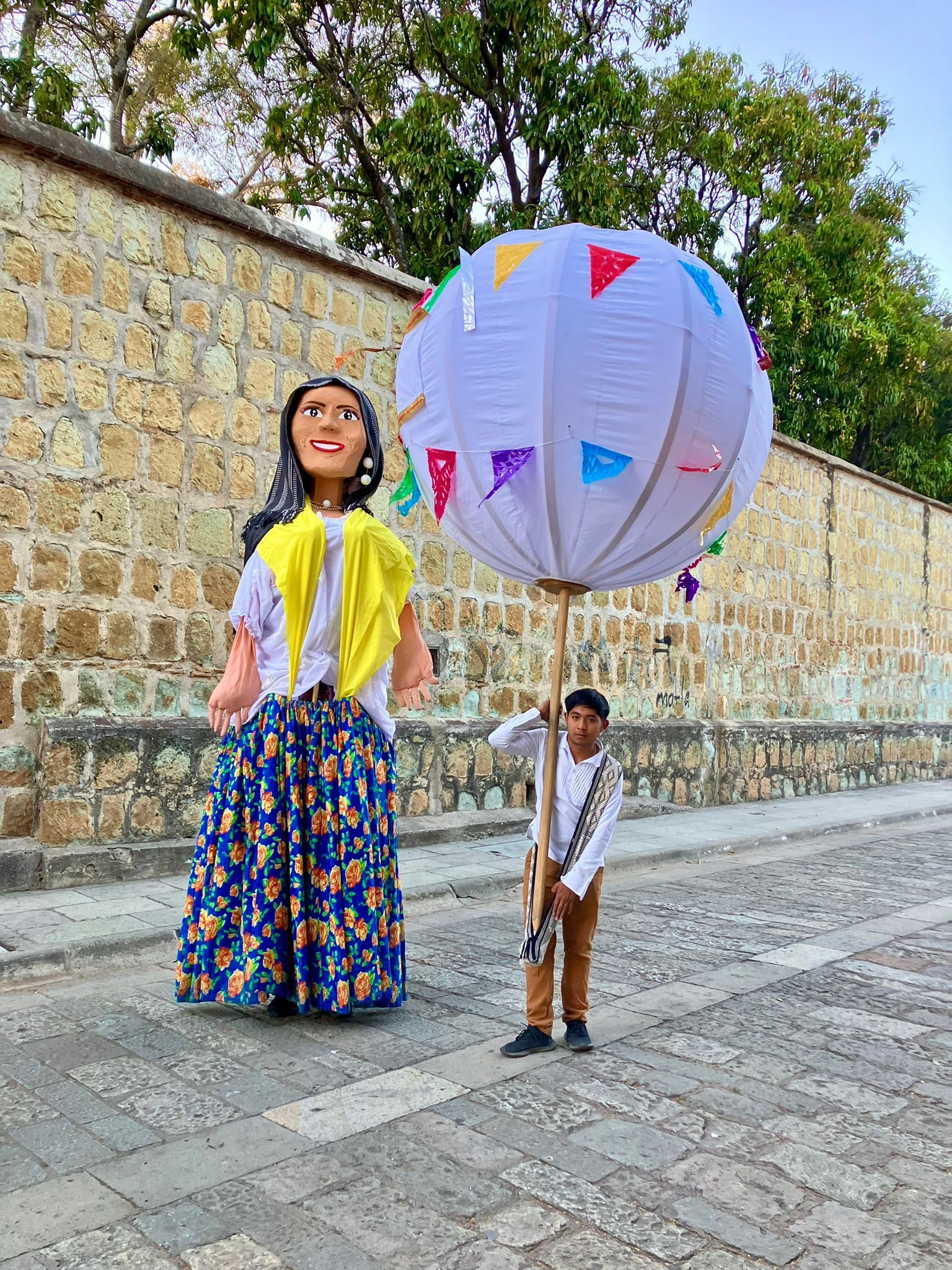
At five in the afternoon, the carnival parade. Oaxaca takes its fiestas seriously — masks, costumes, music, noise, the complete suspension of ordinary street function as the procession moved through the centre. We stood and watched until the colour and the sound had settled into something like happiness.
In the evening, Casa Oaxaca: one of the top fifty restaurants in the world, and the benchmark against which the rest of the week's eating would be measured. The service was of the kind that makes you feel simultaneously attended to and entirely at ease — no performance of formality, simply genuine attentiveness. The food moved through Oaxacan ingredients with the intelligence of a kitchen that understands them completely: mole as you have not tasted it before, textures and temperatures in conversation, presentation that does not subordinate flavour to aesthetics. A meal to remember.
Day 10 — Saturday 14 February: Textiles, San Pablo, Language Exchange
Fabric as Identity, Poolside Politics, and Swiss Gentlemen
We began at the Museo Textil de Oaxaca, and it recalibrated the morning entirely. This is not a dusty display of folded fabrics behind glass. It is a living argument about colour, geometry and identity — indigenous weaving traditions shown alongside contemporary reinterpretations, textiles treated as art rather than craft or artefact. The building helps: thick walls, light-filled rooms, quiet courtyards, the particular serenity of spaces designed to slow you down. You leave seeing pattern differently, noticing what you had previously walked past.
The shop offered some beautiful items, though the prices — up to 17,500 pesos for the finest pieces — reminded me that genuine craft deserves genuine valuation. We looked carefully and left without purchasing.
A few doors down, we found the Centro Cultural San Pablo — a former Dominican convent, beautifully restored, now operating as a gallery, library and cultural centre of particular quality. Stone arches and contemporary design. Students at long tables. Coffee that tasted intentional. We sat longer than we had planned (the wifi is excellent), which is always a good sign.
In the evening, a language exchange at a local bar — one of several such events that Oaxaca's language schools and cultural organisations seem to coordinate. We talked for an extended time with three Swiss men, charming, precise in their questions about English idiom, the peculiarities of British humour, the difference between 'risky' and 'risqué'. We spoke Spanish with two young women from Spain, laughing over grammatical errors, comparing notes on Oaxacan weather (apparently it freezes in December and January — this in a city that felt entirely warm to us) and touching on the English obligation to discuss climate as social lubricant. The evening held the particular pleasure of conversation freed from context.
Day 11 — Sunday 15 February: The Organic Market, Red Bananas, Contemporary Art
A Romanian Linguist, Mole Rojo, and a Market That Felt Like Home
There is something deeply satisfying about buying your supper from a market where the stallholders know their produce intimately — where tomatoes still smell of sunshine and bananas taste the way bananas used to.
At the cafe area of the Mercado Sánchez Pascuas, we drank Chocolate with Agua and found ourselves in conversation — in Spanish — with a woman from Romania who had come to Oaxaca specifically to study the language at the nearby Instituto Cultural Oaxaca. We compared notes on verbs and vocabulary, and laughed at our mistakes. She told us she had chosen Oaxaca because it felt 'real': warm, manageable, large enough to offer culture but small enough to belong to. That word kept coming up. Manageable. As if the city had achieved something cities rarely achieve: a human scale.
While there we bought dinner with specific intent: fresh chicken breasts, green tortillas soft and pliable, deep red tomatoes, an avocado chosen carefully by the vendor, a generous portion of mole rojo — earthy chillies, a trace of chocolate, spice without aggression — and small red bananas, which proved to be a revelation. Smaller than their yellow cousins, intensely sweet without being cloying, almost jewel-like.
In the afternoon, the Museo de Arte Contemporáneo de Oaxaca — MACO — located in a beautiful colonial residence, its internal courtyards and thick walls providing exactly the right atmosphere for contemporary work. The exhibitions were thoughtful rather than overwhelming, exploring identity, memory and landscape in ways that resonated particularly in a region so conscious of its Indigenous heritage. Space to think. No jostling.
Then for dinner we poached the chicken in water with bay and onion, removed and sliced it, made the mole into a sauce with some of the cooking stock, poca a poca, then folded everything into a tortilla with chopped avocado, tomato and jalapeño. The result was far greater than the sum of its parts. The mole rojo tasted of patience and memory — the kind of sauce that carries within it not just ingredients but history.
Markets in the morning, art in the afternoon, dinner assembled from market conversations. Oaxaca rewards those who slow down.
Day 12 — Monday 16 February: The Valley Tour — El Tule, Teotitlán, Mitla
The Oldest Living Thing, Natural Dyes, and the Place of the Dead
We booked directly with Lescas Tours, whose office sits opposite the cathedral on the Zócalo — straightforward, reliable, Ángel our excellent driver and guide. We opted not to include Hierve del Agua in the itinerary; tours are tiring when long, and neither of us was drawn to the water. The shorter circuit proved exactly right.
Santa María del Tule first: the Árbol del Tule, the Montezuma cypress known locally as an ahuehuete — 'old man of the water' — which holds the record for the widest tree trunk in the world. No photograph prepares you for it. The trunk billows and twists like sculpted stone, folding into shapes that locals have named — an elephant, a lion, a man's face — though the tree itself seems indifferent to interpretation. Around thirty people holding hands would be needed to encircle it. It is estimated to be two thousand years old. It was already ancient when the Zapotec civilisation was at its height; it predates the Spanish conquest by a millennium.
Beside it, El Tule hijo — the 'son' of the great tree — already approximately a thousand years old, which in most places would make it the most remarkable thing for miles. Here, it simply provides a sense of continuity: generations growing alongside one another, life extending beyond any human timescale.
The 16th-century church beside the tree — the Templo de Santa María de la Asunción — was built by the Spanish on a site already sacred to the Zapotecs, as was standard practice throughout the conquest: existing sanctity repurposed rather than erased. Standing in the churchyard between the two thousand-year-old tree and the colonial church, you feel the layers of belief systems as something almost physical.
From ancient nature to ancient craft: Teotitlán del Valle, a Zapotec weaving village where the tradition of natural dye and hand-loom weaving continues unchanged in its essentials. We watched wool being cleaned, spun and dyed with cochineal — a tiny insect that lives on prickly pear cactus, producing reds that run from scarlet to deep purple depending on what they are mixed with. Indigo for blue. Marigold for yellow. Pomegranate skin and other plants for earthy golds and greens. Black and white sheep's wool combined for grey. Limestone used to shift and alter the colours. Nothing synthetic.
Then the loom: steady rhythm, shuttle passing back and forth, patterns emerging line by line. Many of the designs carry Zapotec symbolism — mountains, rain, protection, continuity. Watching it is almost meditative. You understand, watching, that this is not craft preserved for tourists but a living practice.
Our final stop was Mitla — the 'Place of the Dead' — a Zapotec sacred site associated with burial, the underworld and the elite priesthood. Unlike Monte Albán's drama of height and openness, Mitla is intimate and architectural. Its extraordinary geometric mosaics — thousands of precisely cut stones fitted together without mortar, mathematical and symmetrical — cover the walls in patterns that feel, at the same time, deeply ancient and almost modern in their abstraction. Each small stone interlocks perfectly with its neighbour. The precision is astonishing.
Above the Zapotec platforms, the Church of San Pablo Apostol — red clay tiled domes, white bell towers, built directly on top of the Zapotec temple. Ángel explained the practice matter-of-factly: practical (ready-made foundations), symbolic (Christian authority asserted over Indigenous sacred space). Looking down at the mixed reused stonework beneath the church walls, you see both histories simultaneously. When we visited, a service was underway. The church was full — voices rising from a building that carries centuries in its foundations.
Day 13 — Tuesday 17 February: Courtyards and Cantera Stone
San Pablo, the Cathedral, and a Church Built on History
We had stumbled upon the Centro Cultural San Pablo by chance two days earlier — we had set out for the Museo Textil and discovered, a few doors down, that heavy wooden doors opened into something entirely different. Today we returned with the intention to visit the site properly.
San Pablo's history is layered in the way that most of the best things in Oaxaca are layered: originally a sixteenth-century Dominican monastery, carefully restored, revealing fragments of old wall paintings alongside contemporary art installations. The combination is precisely right — faded saints and baroque decorative flourishes surviving beside current work, the whole held together by thick stone walls and the particular quality of light in the central courtyard. A biblioteca within the complex reinforces that this is a living cultural hub rather than a preserved monument. And then, unexpectedly anchoring one of the modern courtyards: a striking black obsidian-tiled water feature, glossy and volcanic, ancient material reimagined for a contemporary setting. Very Oaxaca.
The current exhibition featured the work of a Japanese artist responding to Mexico and its people — delicate, thoughtful work that captured colour and movement with a respect that felt genuine rather than appropriative. Cultural distance, used well, can produce genuine illumination.
From there, the Catedral Metropolitana de Oaxaca — the cathedral dedicated to the Virgin Mary, its façade in yellow-green cantera stone, richly carved with saints and scrollwork that glow warmly in the afternoon sun. Inside, the main altar draws the eye upward; in the side chapels, paintings of the Virgin's parents, Saints Joachim and Anne, the human genealogy that Catholic tradition carefully preserves. A reminder that faith, in the Catholic tradition, is also a family history.
And the Templo de Nuestra Señora del Carmen Alto, not far from our hotel: the gilded retablo catching candlelight and spreading gold warmth across the sanctuary. Outside, a quiet garden under trees, away from traffic, birds overhead and warm stone underfoot. Oaxaca reveals itself like this — not always in grand gestures but in these layered, peaceful spaces where history, faith and art have reached a kind of equilibrium.
The church stands on a site of pre-Hispanic significance — a former Zapotec ceremonial platform, its elevated position reflecting the sacred geography beneath it. As in Santo Domingo, as at Mitla: Catholic façades rising from Zapotec foundations. The city is built on its own history, literally.
Day 14 — Wednesday 18 February: Ash Wednesday, Photographs, and Benito Juárez
Purple Lent, Paul Strand on the Shelf, and a Life of Extraordinary Arc
First, the Mercado Sánchez Pascuas for an atole — chaporrada: thick, warm, made from corn masa and chocolate, a traditional drink that functions more like a meal. Too thick for my taste, though I can see entirely why it is beloved. Sustaining and ancient. Darran enjoyed both portions.
Then we walked to the Basílica de Nuestra Señora de la Soledad and stepped directly into an Ash Wednesday service. The church was full — every pew occupied, people standing along the walls, a hushed reverence that was also a strong sense of community. Rich purple cloth was draped around the interior, threaded with gold that shimmered in the candlelight. Angels appeared to float from the walls, each supporting ornate chandeliers that cast warm light across the bright white space. We were visitors, clearly not local, yet there was no sense of intrusion. A welcome to stand and share the moment.
The Centro Fotográfico Manuel Álvarez Bravo occupied the afternoon: a gracious colonial casa dedicated entirely to photography, serious about it in the way that Mexico tends to be serious about its arts. Room after cool room, contemporary photography treated as documentary, political, intimate, rooted in Mexican identity. The photographic library was the revelation: shelves of classic photography books available to browse — not behind glass, not by appointment — simply there, available. We spent time with Mexico by Paul Strand, his powerful study of the country made in the 1930s: stark, dignified, quietly monumental. Peasants, churches, landscapes. Seeing those images while actually in Mexico added a resonance that reproductions cannot provide.
In the central courtyard, a decorative pond: small fish moving lazily beneath the surface, shade, the sound of water. One of the most tranquil places in a city that does tranquillity well.
Then the Casa de Benito Juárez, a few streets away: the modest house where Mexico's most important president lived for twelve years as a boy and young man. He arrived in Oaxaca as an orphaned Zapotec child speaking little Spanish. From these small rooms he would rise to lead the country through civil war, separate Church from State, resist French imperial intervention, and insist that Mexico be governed by its constitution rather than by entrenched power. The rooms are simple. There is not a great deal to see. But standing there makes the trajectory feel extraordinary — and the visit sent us afterward into research about the Reform Laws, the French Intervention, the whole turbulent mid-century of Mexican history that Juárez shaped. Sometimes the most modest museums send you away wanting to read more.
Day 15 — Thursday 19 February: Murals, Museums, and Mozart in a Convent
MUPO, a Philatelist's Dream, and Free Music Under Stone Arches
We had been trying to see the murals in the Palacio de Gobierno all week. Today the building still had other plans: an official event in full swing, the courtyard rearranged for an incoming crowd, officials moving briskly between arches. Restricted access. We resolved to return.
The Museo de los Pintores Oaxaqueños offered the most civilised entry arrangement in Mexico: a 100-peso donation, in return for which a proper cup of coffee and a slice of cake were pressed into your hands. We sat beneath the colonnades of the courtyard until the coffee was finished, then stepped into the galleries.
The exhibitions moved through local artists toward international recognition and back. Fulgencio Lazo's canvases — bright, confident, groups of figures that never feel chaotic — draw you in with colour and reward you with quiet intimacy. Leonora Carrington's surreal, mythic figures seemed entirely at ease in this setting; having encountered her work at The Hepworth Wakefield, finding her here felt like meeting a familiar presence. Julien de Casabianca's Carga Emocional commanded an entire room: enlarged figures carrying palpable emotional weight, less an exhibition than an immersive performance. Hugo Vélez's groups of small oil paintings felt like turning the pages of a visual narrative, each piece a sentence in a larger story.
The Museo de la Filatelia — MUFI — proved that a museum built around stamps need not be dry. Greeting us in the museum: the Vocho MUFI, a 1993 Volkswagen Beetle covered entirely in a mosaic of stamps in Oaxacan textile patterns. Joyful, slightly eccentric, setting the tone entirely. Plus a world map constructed through philately; heavy wax seals; historic coin collections; a beautifully produced short film about textiles. A reminder that every letter ever sent was a bridge between two people — and that a stamp, however small, represents a journey, a message, a moment in time. Plus, a formal collection of letters including those sent from Frida Kahlo to her doctor.
In the evening, the Centro Cultural San Pablo again: this time for a trio of guitarists performing Mozart's Rondo alla Turca, tangos, Oaxacan melodies including La Sandunga, and a touch of Vivaldi. The setting was intimate, the playing accomplished, the audience a gentle mix of locals and visitors. Free of charge, entirely. Oaxaca has a generous culture of open-access events — concerts and performances in courtyards and cultural centres, frequently unticketted, quietly offered to anyone present at the right moment. Keep an eye on social media pages; scan the posters in museum foyers. Some of the most memorable experiences are not advertised.
Day 16 — Friday 20 February: Tamayo's Eye, the Markets, Chocolate
Pre-Columbian Aesthetics, Chamomile Tea, and the Living Pulse of the Mercado
The Museo de Arte Prehispánico Rufino Tamayo holds one of the finest collections of pre-Hispanic art in Mexico — and it feels different from the national collections, because it was assembled by an artist rather than an institution. Tamayo collected not for comprehensiveness but for beauty: funerary figures, ceremonial vessels, objects from Maya cultures, from Veracruz, from Monte Albán. The confident lines, the abstracted faces, the quiet dignity of figures made without self-consciousness about posterity. A collector's eye is visible throughout.
The building is one of Oaxaca's exquisite old casas: open-air courtyard, arches, a central fountain, the sound of water and filtered light creating the contemplative atmosphere that these objects require. You move through slowly.
Afterwards, the contrast could not have been sharper: straight into the Mercado Benito Juárez and Mercado 20 de Noviembre, vibrant and loud and smelling of everything at once. We stopped among the fruit stalls. I ordered chamomile tea; Darran ordered chocolate con agua — dark, rich, lightly spiced — served with a sweet bun. We both dipped pieces into the chocolate, without particular discipline.
Oaxaca has this rhythm: ancient art in serene courtyards, then immediately back into the living pulse of the market. Past and present, contemplation and appetite, within a few streets of each other. The city makes no hierarchy between them.
Day 17 — Saturday 21 February: Mole from Scratch, Tomb 7 Again, and a Barman Who Dreams of England
The Market as Classroom, Patient Cooking, and Outward-Looking Youth
Back to the Mercado Sánchez Pascuas, as always — because in Oaxaca the market is never simply a place to buy food. It is theatre, colour chart, anthropology lesson and social club simultaneously. We moved past pyramids of tomatoes, glossy black beans, piles of dried chillies like folded silk. Women sitting behind mountains of chocolate discs stamped with almonds and cinnamon. The scent of toasted cacao and coriander and woodsmoke. Again, we were gathering the ingredients to make our Chicken Mole dinner - this time Mole Rojo. An elderly lady was making soft tortillas and though she preferred we buy twenty, she kindly sold us four soft blue tortillas, which were delicious. We returned to our favourite fruit and vegetable stall near the entrance, because the fruit and vegetables were beautifully displayed, and always at a price that seemed very reasonable.
Then, while Darran went to find the old railway station — a reminder of the line that once tied Oaxaca more firmly to Mexico's national story — I returned to the Museo de las Culturas to see Tomb 7 from Monte Albán. Somehow we missed it on our first visit. The tomb was discovered in 1932 by Alfonso Caso and proved to be one of the richest archaeological finds in the Americas: the tomb itself Zapotec, the treasures Mixtec — later occupants who understood its sacred prestige. The turquoise mosaic skull is the object everyone remembers, human bone overlaid with tiny tesserae of turquoise, edged with shell and obsidian. Intimate and ceremonial at once. The gold pectorals, the jade beads, the carved bone, the jet ornaments polished to a deep matte black — none of it made for display. Assembled for eternity, it now lives in glass cases. There is an odd intimacy to archaeology: trespassing gently on what was intended to remain sealed.
We met up again to return to the Zócalo, where a vast white tent was erected: here was an education festival, something far more than a school fair. Oaxaca's teachers' movement has long insisted on community-designed curricula, Indigenous language preservation, oral history and local knowledge at the centre of education rather than at its margins. The state is Mexico's most linguistically diverse, home to sixteen recognised Indigenous language families. The festival fell on International Mother Language Day. Children stood beside projects rooted in their communities; speeches carried across the square; around the edges, toy stalls sold balloons and plastic dinosaurs.
That evening, upstairs in a small bar overlooking the street, a young barman told us of his dreams to visit England. He knows about red telephone boxes. He imagines snow as romantic, and says he would enjoy the cold. I did not have the heart to describe a damp Yorkshire January. But I admired his curiosity — Oaxaca seems full of young people with outward-looking ambition and deep local roots, the two things sitting comfortably together.
We made our mole and when we finally sat down with the chicken and tortillas and avocado, it tasted of smoke and chocolate, heat and sweetness.
Day 18 — Sunday 22 February: The Government Palace, the Tlayuda, and a Philanthropist's Gift
Murals as Arguments, History Pressed in Corn, and What Investment in Culture Looks Like
Persistence paid off. We finally entered the Palacio de Gobierno.
The mural cycle by Arturo García Bustos — a student of Frida Kahlo, working firmly within the tradition of the great Mexican muralists — sweeps through Mexican history with urgency rather than decorativeness. The story begins before the Spanish: Indigenous civilisations, agriculture, astronomy, stone cities rising from valleys. Then the rupture of conquest: exploitation, forced conversion, the extraction of wealth. The War of Independence, Hidalgo and Morelos emerging from the crowd. Reform and Revolution: Benito Juárez, Oaxacan himself, stern and upright; Emiliano Zapata with his uncompromising gaze; peasants demanding land; workers demanding dignity.
The style is bold, didactic, unapologetically political — murals as arguments rather than decoration. What struck me most was how Indigenous presence runs through every panel not as prologue but as foundation. The mural does not treat pre-Hispanic civilisation as background to the main event. It treats it as the main event, from which everything else follows.
After days of markets and museums and street conversations, standing in front of these murals felt like a coherence: archaeology, market economics, food culture, political history — suddenly readable as a continuous story.
In the city hall: the Ripley's Tlayuda, officially recognised as the world's largest tortilla. What might seem merely playful reveals itself on closer inspection as something more considered: a colossal crisp tortilla mounted like a ceremonial shield, its surface textured with scenes from Oaxacan history — pre-Hispanic rulers, colonial churches, maize, markets, revolutionaries. Gold and turquoise and painted figures in baked-earth tones. History pressed into corn. In Oaxaca, even street food can become a canvas.
We returned to Centro Cultural San Pablo — a quiet oasis throughout our time in Oaxaca — and learned more about Alfredo Harp Helú, the philanthropist behind its restoration. A banker who sold his institution to Citigroup, he was kidnapped in 1994 and held for over a hundred days. Much of his subsequent philanthropy has focused on cultural preservation and education in Oaxaca. Sitting in that courtyard, surrounded by students and books and the particular quality of the afternoon light through stone arches, you can see what investment in culture looks like when it is rooted locally rather than imposed from outside.
Day 19 — Monday 23 February: Departure for Puebla
Jalatlaco Farewell and the ADO Platinum North
A final coffee at the cultural centre — because some places earn their ritual status. A morning walk through Jalatlaco for more photographs, unhurried now, familiar with the streets. At the Templo de Nuestra Señora del Carmen Alto, another service in progress, well attended, the congregation spilling out into the shaded garden. Every time we went there was a service taking place, so I never managed to take any photos inside this beautiful church.
We had spent two weeks in Oaxaca, and it had rewarded every one of them. The city gives itself gradually, in proportion to the time you invest. Markets, museums, music in courtyards, conversations that went longer than planned — all of it layered against the extraordinary backdrop of Zapotec and Mixtec history that is not, here, abstract or academic but present in the stones of the buildings, the patterns of the textiles, the ingredients in the mole.
The ADO Platinum bus to Puebla departed on time. Four hours north, reclining seats, the landscape shifting as we rose back toward the central plateau. Puebla for a week.
Day 20 — Tuesday 24 February: Puebla
The Capilla del Rosario, a 17th-Century Library, and a Bed Like a Fairy Tale
The bed in our room at the Quinta Real Puebla, a former convent, reminds me of the princess and the pea. No further comment necessary.
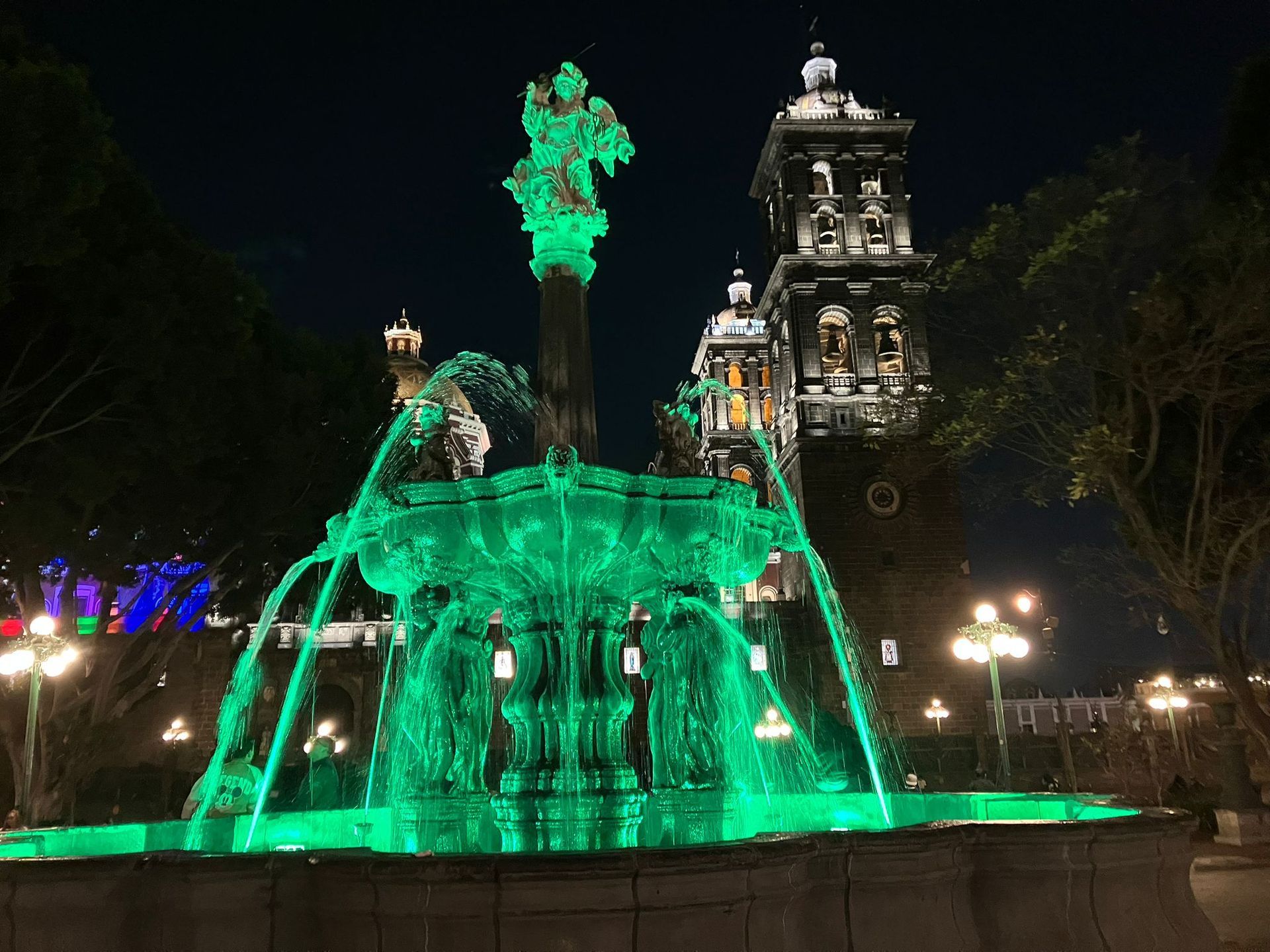
Puebla's Zócalo on a cool morning: broad, green, composed. It feels different from Oaxaca's — more sedate, more self-contained, anchored by the immense cathedral on one side and the confidence of a city that knows it has an interesting story. The light was soft and the air still fresh as we arrived.
From the square we walked to the Templo de Santo Domingo. The nave felt initially restrained — almost austere by Oaxacan standards. Then we turned toward the altar and looked left, and there was the Capilla del Rosario: a complete eruption of gold. Every surface animated — gilded stucco, swirling angels, intricate theological symbolism, luminous paintings. The white and gold ceiling caught the light in a way that made the entire chapel shimmer. It is theatrical, yes. But devotional too. A space designed to lift the eyes and the spirit simultaneously.
Coffee at Pastelería La Esperanza, with glass cases of immaculate sweet pastries, refrigerators full of gateaux, families lingering at tables. Something reassuringly European in its rhythm yet entirely Mexican in its flavours.
Then the jewel of the morning: the Biblioteca Palafoxiana, founded in 1646 by Bishop Juan de Palafox y Mendoza, one of the finest colonial libraries in the Americas. The wooden shelving rises in three tiers, lined with thousands of leather-bound volumes. Standing inside feels like standing inside a preserved seventeenth-century mind — theology, mathematics, literature, the full ambition of European intellectual life transported to New Spain. The current exhibition was generous and clearly curated, explaining Palafox's vision of a library open to scholars. Among the exhibited treasures: early editions of Don Quijote, The Divine Comedy, works by Euclid. A library is always a form of argument about what knowledge matters; this one makes its argument with extraordinary confidence.
We returned to the cathedral — immense in scale, different in feeling from its European counterparts. The doubled confessional boxes, open and visible. The enormous circular altar to the Virgin Mary. Counter-Reformation clarity rather than medieval mystery: a church designed to teach as much as to awe.
Then a late lunch at Sanborns — reliable, civilised, unhurried.
Day 21 — Wednesday 25 February: Puebla's Famous Battle.
Cinco de Mayo, Ari's Pizza, and the Fort That Began as a Hermitage
The Uber dropped us at the Plaza de la Victoria Fuertes — the open ceremonial space that anchors the whole Cinco de Mayo complex on the hill above Puebla. It sets the tone immediately. The plaza is broad and unhurried, its proportions scaled to commemorate rather than merely mark: a space designed to make you conscious of standing on ground that mattered. Monuments and pathways draw the eye outward, and the views from up here are extraordinary — the whole city spread below in its baroque density of domes and towers, and beyond it, filling the horizon with a presence that never quite becomes ordinary no matter how many times you have seen them, Popocatépetl and Iztaccíhuatl. The volcano and the sleeping woman, side by side, one trailing smoke, one in perfect stillness.
Then the Museo Interactivo del Cinco de Mayo — a lively, well-designed introduction to the battle of 5 May 1862 and the extraordinary circumstances that produced it. A young woman named Michelle guided us through the exhibits with the particular enthusiasm of someone who has chosen her passion freely. She is an Anglophile who loves English history, and there was something pleasing about that exchange: a Mexican woman explaining Mexico to two English visitors with reference points that ran from Puebla to Parliament. She walked us through the principal figures: Ignacio Zaragoza, the general who led the Mexican forces against a French army widely considered unbeatable; and Porfirio Díaz, cavalry commander at the battle and — in that moment at least — a hero.
The question of Porfirio Díaz occupied us longer than most. He drove the French out, then spent thirty-five years transforming Mexico into a would-be Paris, then refused to leave power, then fled to Paris and died there. His remains are at Montparnasse. History, as Michelle acknowledged with a slight smile, declines to simplify.
From the museum we walked a short distance to a nearby pizza outlet, open-fronted onto the street, run by a man named Ari whose British and American accents were both uncannily accurate.
From there we walked up to La Fuerte de Loreto — the Fort of Loreto — which began its life not as a military installation but as a hermitage, a place of solitary religious retreat on the hill above the city. The Spanish built it in the sixteenth century; the military utility of its elevated position on the edge of Puebla was recognised later, and by 1862 it had become one of the key defensive positions in the battle against the French. The museum housed within it goes deeper into the campaign: the French return the following year, Puebla's eventual fall, the installation of Maximilian as Emperor and his subsequent execution. Triumph, occupation, tragedy and republic — all within a decade.
The café owner's comment, offered in passing as we left: he was glad it was the Spanish who had colonised Mexico and not the English. We asked him to elaborate. The conversation that followed was, in equal measures, uncomfortable and illuminating — as the best conversations tend to be.
The walk back down from the fort passed the Mirador de Puebla, where the city opens out beneath you and we stopped at El Cielo café for a drink, letting the view do its work. It is one of those pauses that earns itself.
We had been told about the tunnels: a network running beneath the hill, originally dug for military purposes, now open to visitors as a way of descending back into the city on foot. This seemed an appealing prospect — the idea of moving from fort to centre underground, the hill itself hollow beneath us. We found the entrance, consulted the signage, and discovered that the tunnels operate in one direction only. You enter at the bottom and walk up.
I was not going to walk down to the city simply to walk back up through a tunnel. We took the sensible route instead, which was less romantic but considerably more reasonable, and arrived back in the centre with our dignity and our knees intact.
Day 22 — Thursday 26 February: Cholula — The Hill That Was Never a Hill
Eight Kilometres of Tunnels, a Church Built in Error, and University Students Beneath Volcanoes
Having researched a few different ways of getting to Cholula, we chose to use an Uber.
Some places impress you with height. Cholula astonishes you with depth.
At first glance, you see a church on a hill. Tiled-domes, serene, the Santuario de Nuestra Señora de los Remedios looking as though it has always belonged there, watching over the town and the distant sprawl of Puebla. But the hill is not a hill. It is the vast body of the Gran Pirámide de Cholula — the largest pyramid in the world by volume — and the church was built on top of it because the Spanish, arriving in the sixteenth century, did not know it was a pyramid. By then the structure had been abandoned for centuries: eroded, overgrown, convincingly naturalistic. They built on what they took to be a hill with a commanding view.
When we arrived in Cholula we walked up the sloping path to the church, from the top we could see the steaming Popocatépetl and more dormant Iztaccíhuatl. We walked into the Church, the Santuario de Nuestra Señora de los Remedios, and this beautiful church has a palette that is soft and luminous — pale creams and warm golds catching the light, with colourful devotional paintings brightening the walls and side chapels. Gilded details frame the altar, while saints gaze down from painted panels in rich reds, blues and greens. Yet this serenity exists in a restless landscape. The church has been shaken repeatedly by earthquakes, most recently in 2017, when cracks appeared and restoration work became urgent. Repairs have strengthened walls and stabilised the structure, but the sense remains that this is a sanctuary accustomed to tremors — faith and fragility held in delicate balance high above the ancient pyramid below.
It was not until 1910 that construction work exposed ancient stonework and archaeologists began to understand what lay beneath. What followed was one of the most unusual excavation projects in the Americas: rather than dismantle the mound and disturb the church above it, archaeologists tunnelled inward. Over decades they carved approximately eight kilometres of tunnels through the pyramid's interior, revealing multiple construction phases — earlier pyramids buried within later ones — murals, ceremonial spaces, a complete architectural biography of accumulated centuries.
After a coffee at The Italian Coffee Company we walked to the archeological site, you realise you are not looking at a monument but at time made spatial. At the archaeological site of Great Pyramid of Cholula, the scale only becomes apparent as you begin to walk it. We passed low stone altars set within open plazas, the remains of sloping talud walls and fragments of staircases that once channelled processions upwards. Although the deeper tunnels and main mural were closed, we were still able to glimpse entrances to the passageways that honeycomb the pyramid’s interior, hinting at the earlier structures buried within. Step by step, the layers revealed themselves — and finally we climbed a restored pyramid platform, ascending as worshippers once did, the vastness of this ancient ceremonial centre unfolding beneath an open Mexican sky.
Directly opposite the main pyramid as you leave: another grassy mound. Still covered. Still apparently a hill. Still holding its own pyramid.
The nearby site museum is compact but excellent, including a scale model of the entire complex that makes clear the pyramid's alignment with the solstice and its cosmological relationship to the surrounding volcanoes. A reproduction of the Mural of the Drinkers; a copy of the Grasshoppers mural; replicas of codices. The museum contextualises rather than overwhelms.
The town of Cholula has an additional quality that changes its atmosphere entirely: it is a university town. The Universidad de las Américas Puebla — UDLAP — sits just minutes from the archaeological zone, its eight or nine thousand students distributed between the campus and the cafés and bars of the town. American students on semester abroad programmes; South Americans studying economics and engineering; Spanish students drawn by shared language and lower costs; European students exploring Latin American politics. The combination of ancient pyramid, colonial church and international student population sitting in rooftop bars beneath active volcanoes is, to put it simply, unlike anywhere else.
We had lunch at Caravana Cholula — excellent tacos in a lively, unfussy setting — then coffee in Plaza de la Concordia, watching families and students moving through the town. There is a genuine holiday feel here: lived in, not preserved.
The day ended at La Pasita — the legendary Cholula liqueur bar, famous for its namesake raisin liqueur — followed by more tacos nearby, then back to Puebla and the hotel, where a string quartet was playing in the courtyard: Stairway to Heaven, Coldplay, Queen, Taylor Swift, all rendered on strings with considerable style.
Day 23 — Friday 27 February: Locomotives, Revolution, and the Long Night
Steam Engines, Bullet Holes, Pulque at the Bar
The Museo Nacional de los Ferrocarriles Mexicanos is built around Puebla's former railway station — platforms, sidings, ironwork intact — and much of the experience happens outdoors, under the sky, among the locomotives. Heavy black steam engines, dignified and slightly theatrical. Later diesel models. Polished passenger carriages with curved roofs and brass fittings. You can wander freely between them, step up into carriages, imagine the long journeys north to Mexico City or east toward Veracruz.
One carriage has been converted into a small library; inside, we were given paper birds, each folded around a poem. It felt unexpectedly tender: a gift of words in a place once dedicated to motion. The indoor exhibition includes the music composed for the railway's opening — ceremonial, optimistic, full of forward momentum. That spirit of progress is almost poignant now, given what followed.
Puebla, a city of over a million people, no longer has passenger rail services. In nearby Cholula, a sleek modern station stands empty — no trains. For someone who loves railways, it is genuinely hard not to feel the loss of what these lines once were: connective tissue between communities, industries and landscapes, now preserved as artefact rather than functioning as artery.
A traditional café directly opposite the museum — simple tables, unpretentious menu, a mural of dogs playing cards — provided coffee and a fresh sandwich before we continued on foot. Puebla rewards walking: compact, colourful, constantly revealing something new between buildings you have passed before.
From there to the Museo de la Revolución Mexicana Casa de los Hermanos Serdán: the building that still bears the marks of gunfire from 18 November 1910, when federal troops discovered the Serdán family's plans to rise against Porfirio Díaz and violence erupted in these rooms. Bullet holes in the façade. Bullet holes in the walls inside. A bullet hole in a sitting-room mirror. Aquiles Serdán chose principle over safety, and the house where he made that choice has been kept exactly as the gunfire left it. The Mexican Revolution did not begin as an abstraction. It began in rooms like these.
Taken together — the railway museum and the revolution house — the two sites form a powerful pairing: one celebrating the confidence of a modernising nation under Díaz, the other marking the moment that confidence fractured. Steam engines and bullet holes. Opening ceremonies and shattered mirrors.
Supper at Don Pastor Catedral, directly opposite the cathedral: tacos al pastor, fast and flavourful, exactly right after a long day of walking. Then to the mezcalería across from our hotel for a glass of pulque — cloudy, thick, faintly tangy, the oldest fermented drink in Mesoamerica — letting it stretch the evening out properly.
Day 24 — Saturday 28 February: Museo Amparo, Convent Kitchens, and Three Moles
Olmec Faces, a Missing Stela, and a Trilogy of Sauces
We began at the Museo Amparo, with its pre-Hispanic sculptures downstairs, contemporary installations upstairs, and from the rooftop terrace, great vistas of Puebla's rooftops and domes rising toward the volcanoes.
The pre-Hispanic galleries are beautifully arranged: Olmec faces emerging from shadow, Maya carvings worn smooth by centuries, ceramic figures that still seem to carry breath. In the section exploring the Usumacinta region, references to Alfred Maudslay — the Victorian archaeologist who travelled through the Chiapas jungle to sites like Yaxchilán in the 1880s, photographing monuments and making plaster casts of stelae so that their inscriptions could be studied in Europe. His work introduced the Maya world to a wider audience, inevitably through a lens of 'discovery' — but the documentation was real, and its value persists.
Upstairs: Erick Meyenberg's installation All Night Long, Birds Were Heard Passing — the title taken from Columbus's journal, written hours before land was sighted in 1492. The sound of birds meant hope to exhausted sailors. And that same moment marked the beginning of colonisation. The installation — film, archive, symbolism — holds both readings simultaneously. Birds as witnesses to discovery and to rupture.
Another exhibition explored the Usumacinta River and the ecology of the Maya heartland. One story stopped me entirely. In 1964, officials selected twenty stelae from Yaxchilán for transport to the newly opened Museo Nacional de Antropología. Nineteen arrived. In 1965, the Swiss photographer and environmentalist Gertrude Duby Blom — widow of the archaeologist Frans Blom — found the missing monument, Stela 11, on a riverbank near Agua Azul, partially submerged, being used as a washing stone. She arranged for its return to Yaxchilán. It was never restored to its original position. More than sixty years later, La Reina — the Queen — remains in a clearing, safe from the river but still waiting. The thread is clear: Maudslay documenting, institutions relocating, Duby rescuing, contemporary artists questioning. Each generation leaving its mark on the same stones.
The Museo Amparo earns its reputation entirely — the collection is exceptional, the curation intelligent, and the presentation never gets in the way of the work itself. It is the kind of museum that makes you recalibrate what a regional collection can achieve. Later in the week we would encounter the museum again in the Zócalo, where they were running an open-air workshop making the distinctive Talavera-style pottery vessels — great three-footed pots taking shape at long tables, hands deep in clay, the whole thing unhurried and entirely public. An institution that takes its work outside is one that understands who culture actually belongs to.
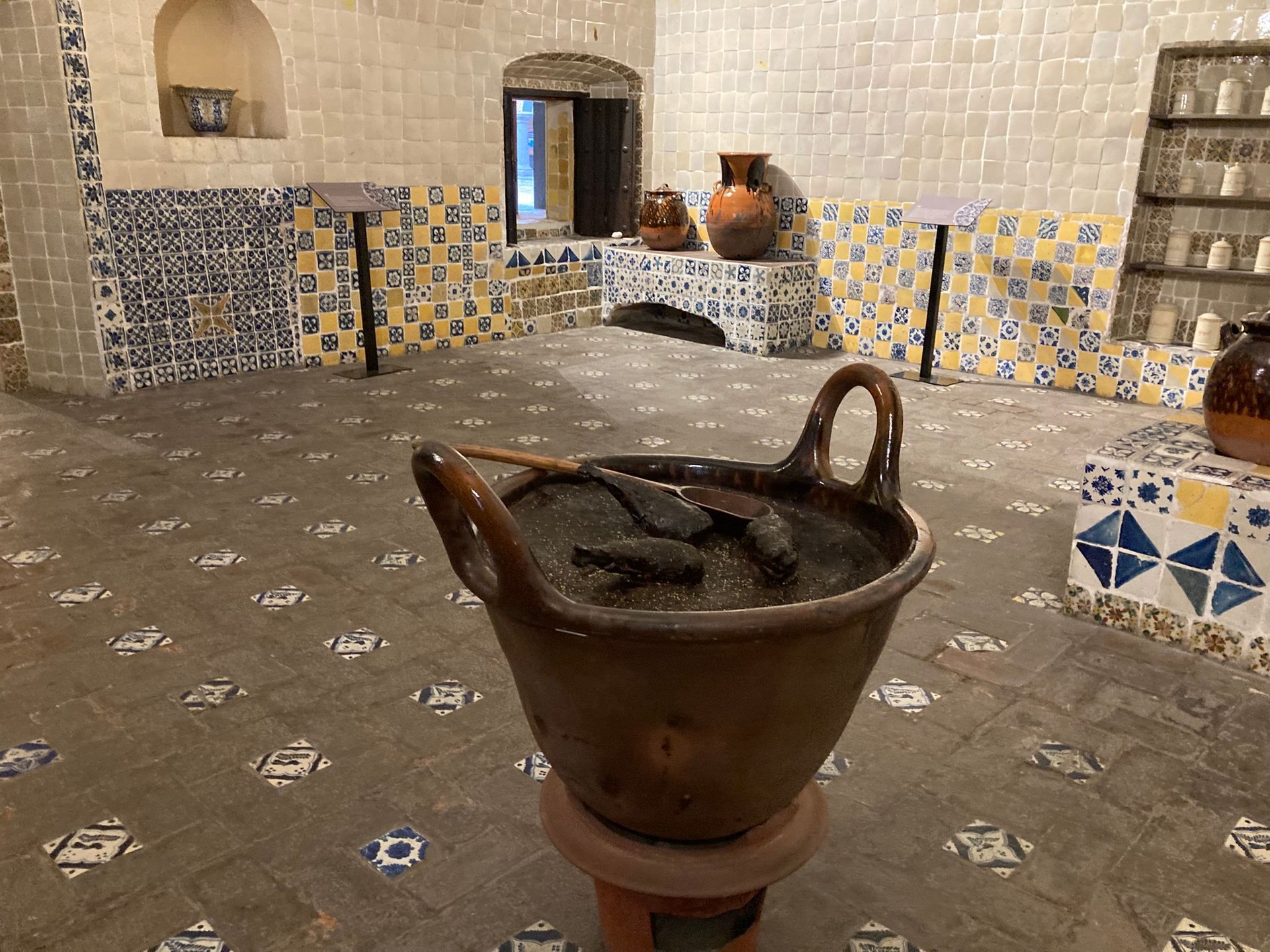
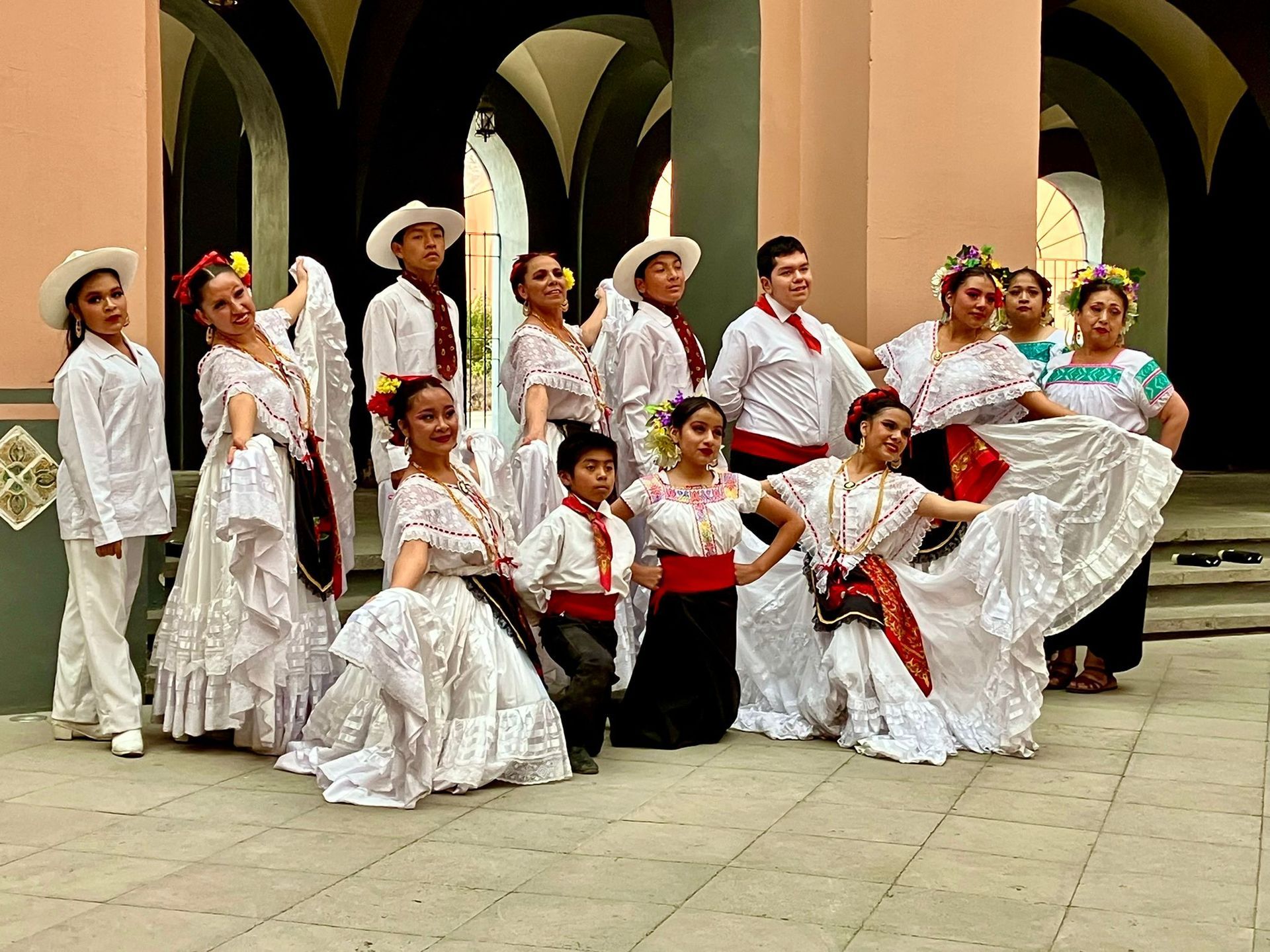
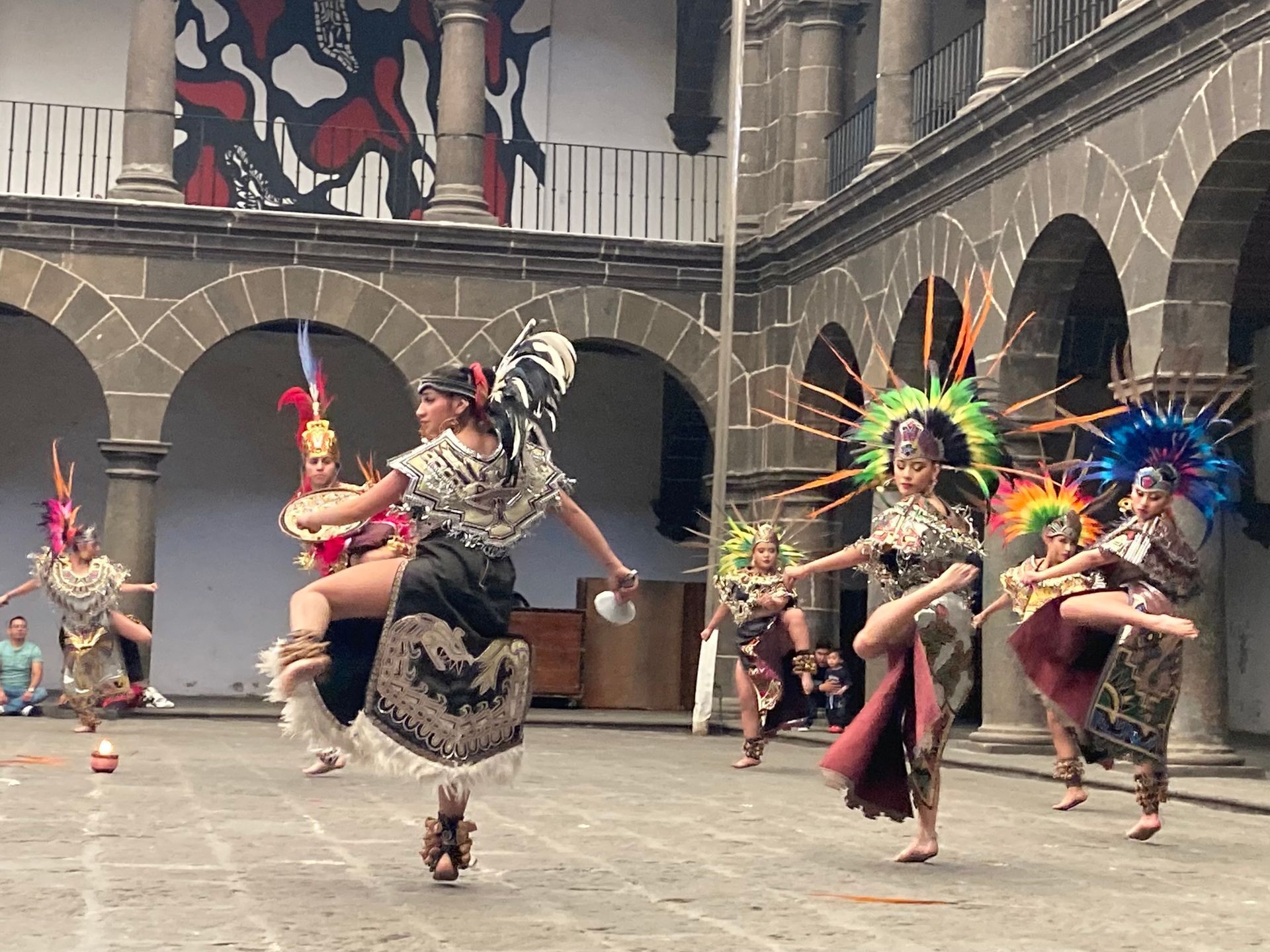
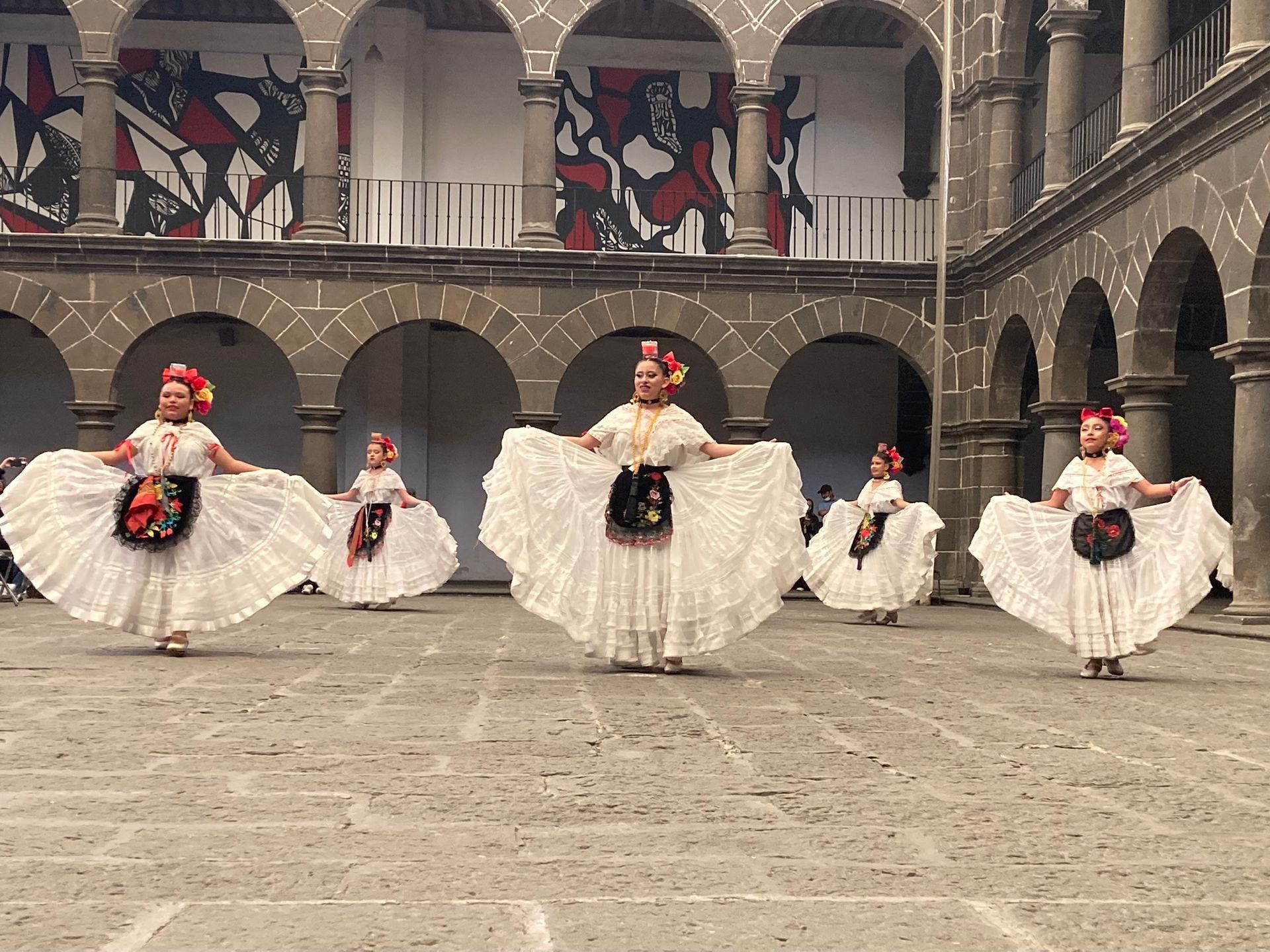
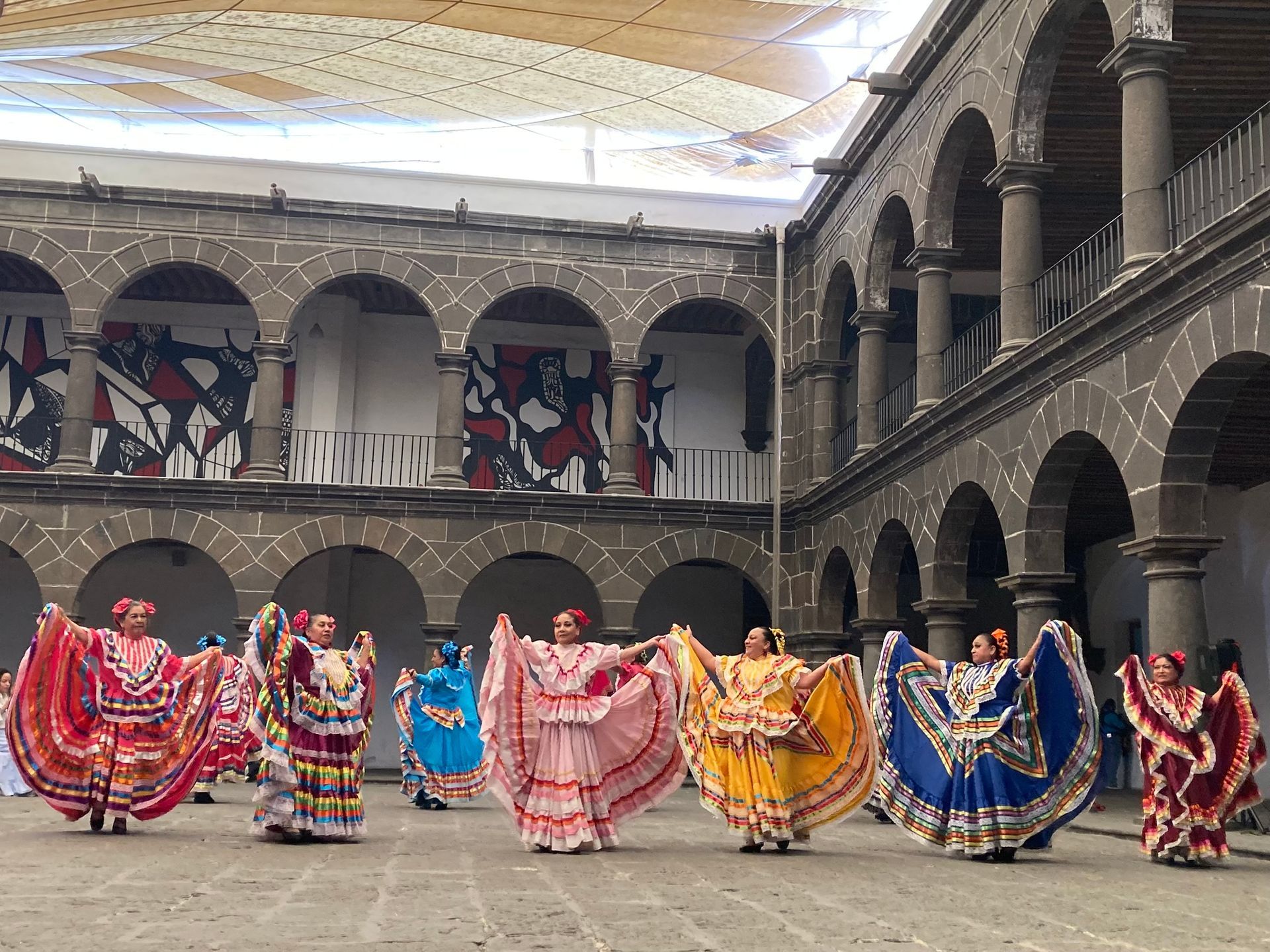
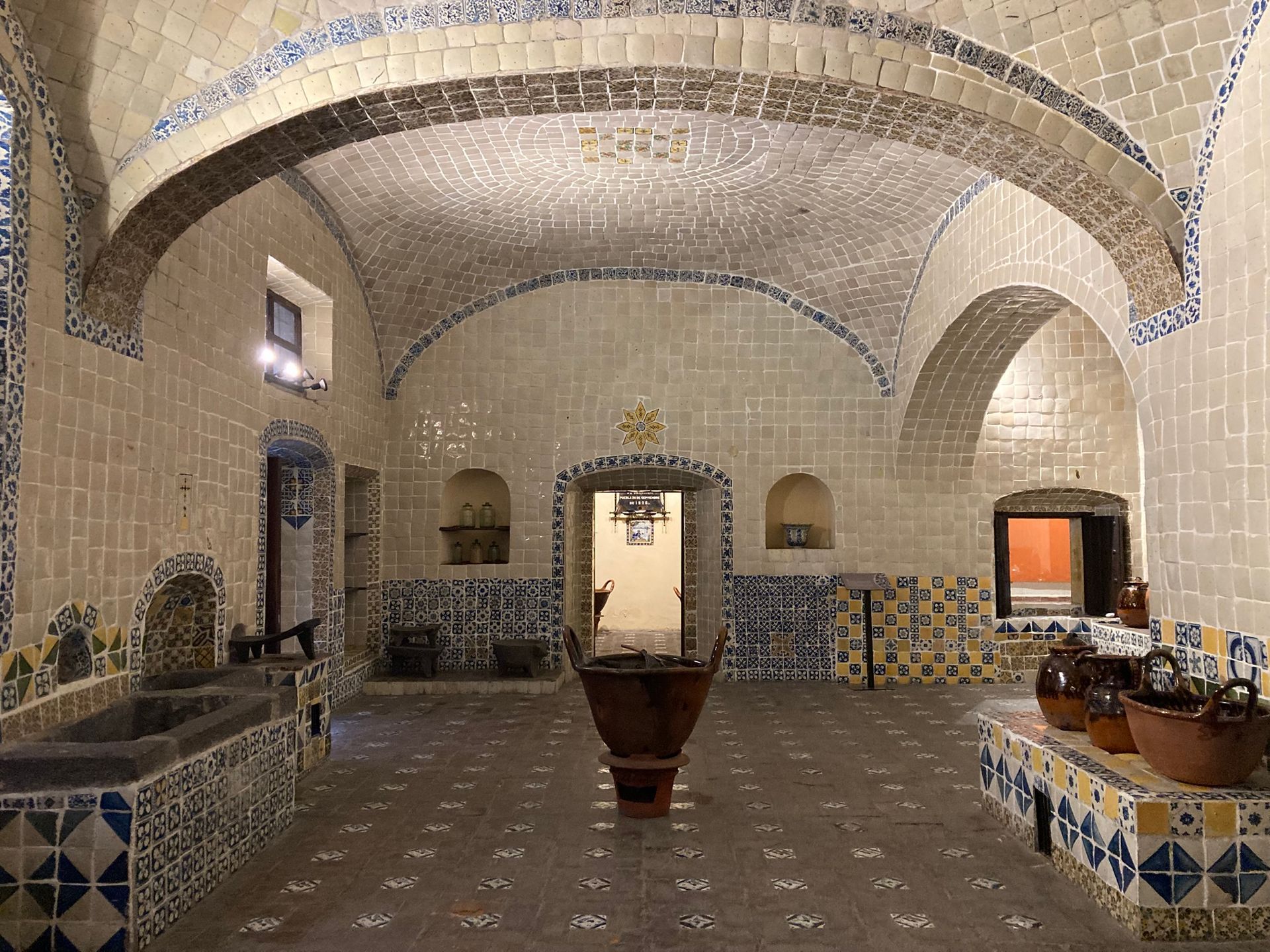
In the afternoon, the Convento de Santa Rosa de Lima — its kitchen entirely covered in blue-and-white Talavera tiles, glowing softly in filtered light. Our guide explained the community's life, its prayer and service. Ceramic Trees of Life the Holy Trinity, elaborate China Poblana dress, regional textiles. Then, in one of the courtyards, a dance performance began featuring two groups of dancers — one mostly young girls, the other mostly women — all dressed in traditional clothing. In one scene, a young girl and boy playfully ‘fought’ over a pottery vase; when the boy’s antics led to it breaking, he carefully replaced it, and the pair departed laughing and reconciled. Another performance featured long, colourful ribbons, which the dancers wove and twisted with their movements to create a living, three-dimensional ‘cat’s cradle’ that shimmered across the courtyard.
We found details of this performance on the Museos Puebla Facebook account.
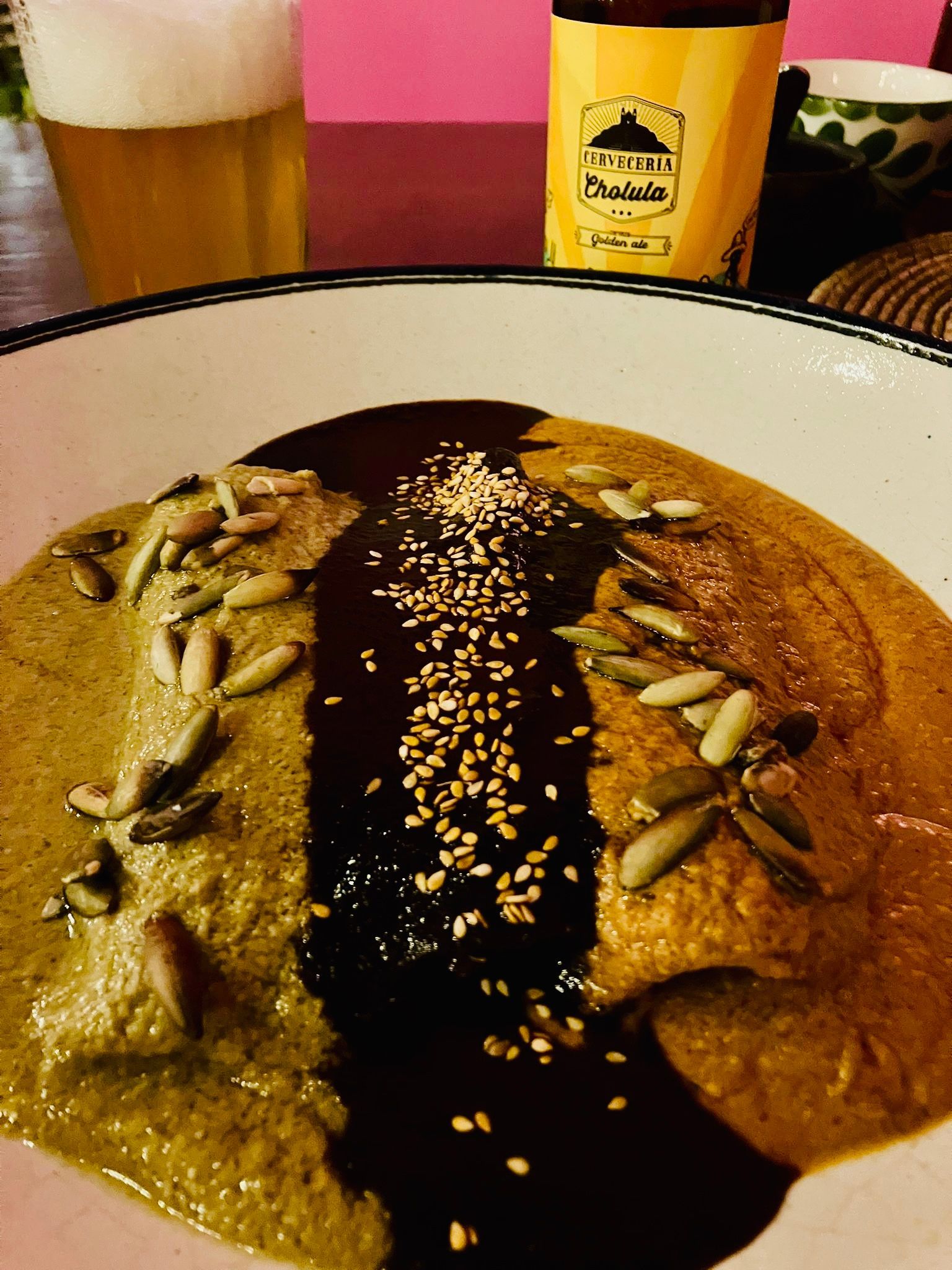
Dinner at Augurio: Enmoladas de Pollo en Trilogía de Moles — three tortillas, each dressed differently. The mole poblano deep and velvety, dark with chillies and chocolate. The pipián rojo warm and nutty with pumpkin seeds. The pipián verde bright, fresh, herbal. Three sauces, three centuries of culinary inheritance, 260 pesos.
Day 25 — Sunday 1 March: Automobiles, Volcanoes, and Violins in the Square
Chrome Through Time, Environmental Protest, and the City as Concert Hall
The Museo del Automóvil Puebla traces more than a century of automotive design with an eclecticism that is genuinely enjoyable. Early 1900s models sit upright and dignified, their brass fittings polished, their narrow tyres almost delicate. By the 1930s and 40s, curves have softened and confidence has grown. Post-war optimism gleams in chrome. A section devoted to British cars produced a slightly disorienting familiarity — sleek Jaguars and sturdy Austins appearing unexpectedly in central Mexico, design carrying national character across oceans.
And then, delightfully surreal: the Papamóvil — the specially adapted vehicle used for papal visits. Somewhere between religious artefact and mechanical spectacle, it seemed entirely at home in a country where faith and pageantry have always understood each other.
From pistons and polish to the Mirador de Puebla, where the city opens beneath you. From the café terrace, domes and church towers seem almost choreographed. And beyond them, faint but commanding, Popocatépetl: a wisp of smoke drifting upward, the reminder that this landscape is alive beneath its beauty.
Back in the Zócalo, an orchestra was playing — brass shining, strings rising above the hum of the city. Live classical music in a public square, entirely free, entirely communal. One of the things that Puebla does consistently and well.
At the San Pedro Museo de Arte, in the vast courtyard, a traditional dance performance unfolded: skirts swirling, heels striking rhythm against the stone. Different groups took their turn. Older women moved with practised grace, their long, floating dresses sweeping the ground as they smiled at one another. Then came younger dancers — girls in brightly coloured, full-skirted dresses that flared with every spin, and three boys in crisp white suits and cowboy-style hats, their choreography full of jumps, stamps, kicks and sharp heel strikes. Finally, a group performing in Indigenous-style dress entered, joined by a male dancer who circled them holding a flaming bowl, weaving fire into the rhythm.
Again, we found details of this performance on the Museos Puebla Facebook account.
In the Zócalo again, a pottery workshop organised by Museo Amparo — children and adults shaping clay at long tables in the open air, hands muddy, laughing. A few metres away, environmental protesters with banners. Both felt entirely in keeping with Puebla's character: a city that keeps its cultural and civic life visible.
Dinner at El Comal: mini cemitas — Puebla's sesame-seeded sandwiches, generous and satisfying — with refried beans and arroz rojo. Then back to the Zócalo, where the night became a slow rotation of musicians. A lone guitarist. A cellist drawing deep, resonant notes. A string quartet transforming the square into an open-air chamber hall. A keyboard player with a microphone, couples swaying under the trees. Each performer creating a different atmosphere; together, a kind of urban symphony.
Day 26 — Monday 2 March: The Last Hour in Puebla
Frogs, Two Police Officers, and a Promise to Return
Sixty minutes before leaving for the ADO bus to Benito Juárez Aeropuerto, we set off without a plan. The best kind of departure.
Callejón de los Sapos — the Alleyway of Frogs — its cobbled stones, antique shops half-open, vintage furniture on the pavement, artists setting up small displays of prints and ceramics. The slightly bohemian energy of a street that has found its own identity. Cafés you mentally bookmark for next time. Puebla is very good at making you promise to return.
Then back to the Zócalo to simply sit. Cathedral bells marking the hour. A shaded bench. After days of museums and convents and mole tastings and rooftop views, it felt right to just be.
Two young Mexican police officers were standing nearby, relaxed but observant. We started chatting. One told us that when he returns to his village, he speaks his Indigenous language at home — a reminder that Mexico's linguistic richness is not listed in guidebooks but lived, daily, in ordinary family life. The other spoke Korean and Japanese alongside Spanish and English. A police officer in Puebla, bilingual in East Asian languages, proud of his city and curious about ours.
We laughed, compared notes on travel, and ended up taking a photograph together. Just young professionals, warm and open, happy to talk.
It was such an ordinary moment. And perhaps the most memorable of the day.
Puebla had given us the Capilla del Rosario and the Biblioteca Palafoxiana, bullet holes in a revolutionary's walls and locomotives at rest under the sky, mole in three colours and string quartets playing Taylor Swift in a colonial courtyard. In our final hour, it gave us something quieter: warmth, openness, and a reminder that a country holding both deep tradition and cosmopolitan confidence in the same conversation is a country worth paying attention to.
Then bags, and the bus. Hasta luego, Puebla.