Final week in Mexico
Puebla: One Week in the City of Mole
The ADO Platinum bus from Oaxaca to Puebla took four hours. The seats reclined, and the landscape shifted as we gained altitude, returning to the central plateau.
Puebla was founded by the Spanish in 1531, one of the few colonial cities in Mexico not built on top of an existing settlement. Its grid layout gives it a different character from Mexico City or Oaxaca : more orderly, more composed. We stayed at Quinta Real Puebla, a former convent, in a room with a bed of improbable height and softness.
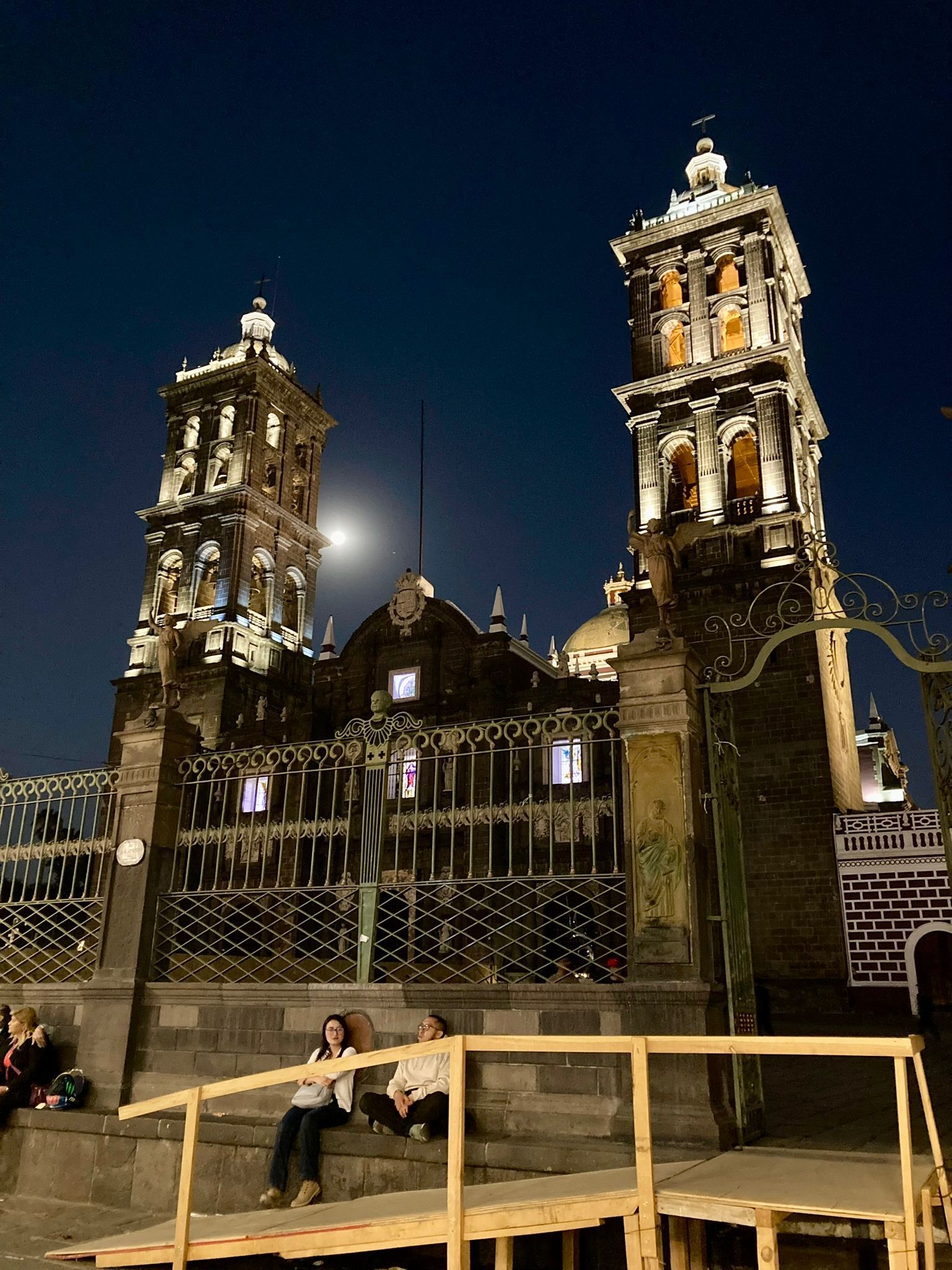
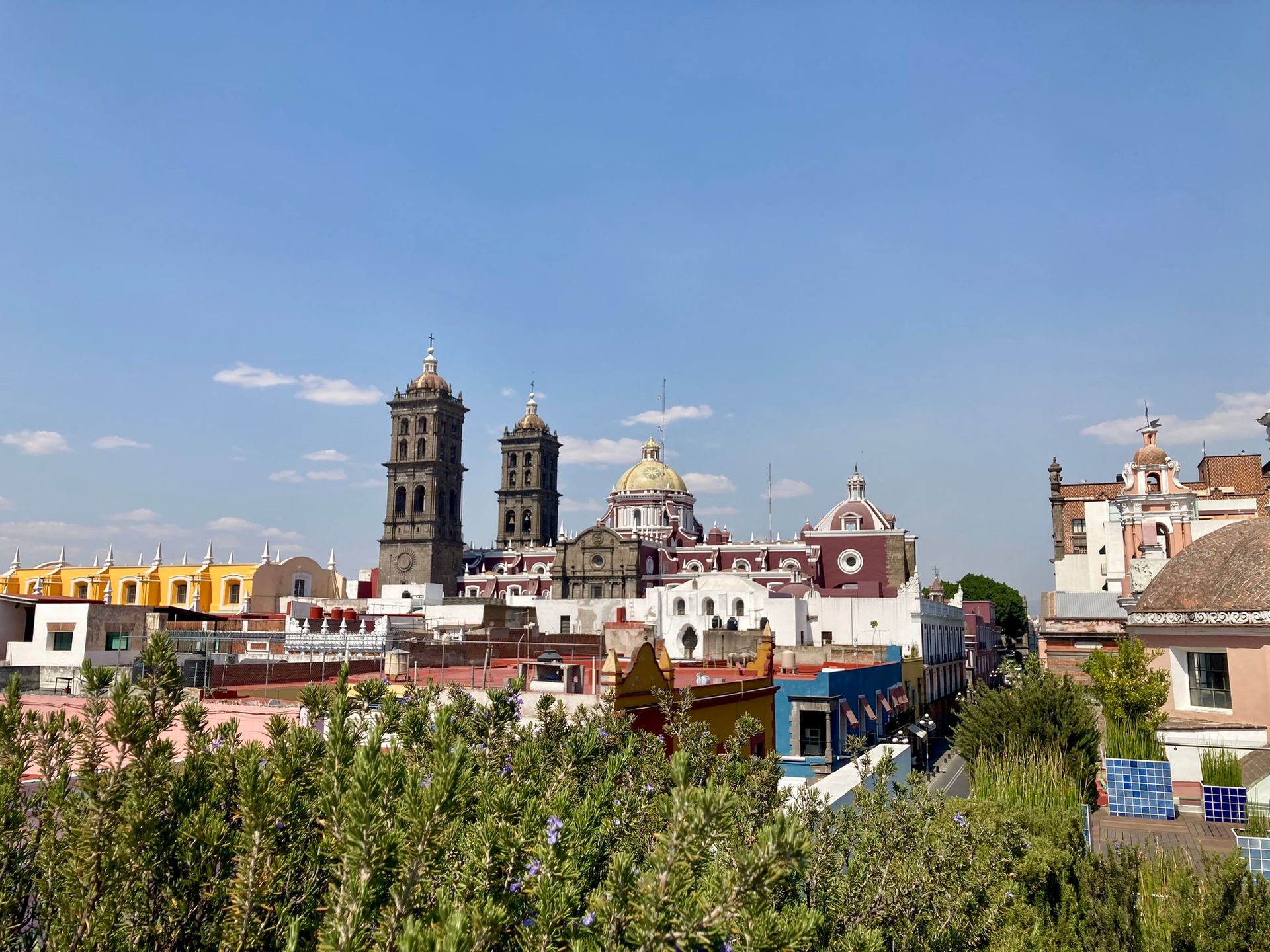
The Zócalo was broad, green and quiet on a cool morning. The cathedral was immense, anchoring one side of the square, while arcaded buildings housed cafés and shops. It felt more European than either of the cities we had come from.
— — —
In the Templo de Santo Domingo, the nave was relatively plain by the standards of Oaxaca. Then we reached the altar and turned left.
The Capilla del Rosario was something else entirely. Every surface was animated with gilded stucco, carved angels and dense theological imagery. The gold shimmered. It was one of the finest examples of Mexican Baroque we saw anywhere on the trip.
The Biblioteca Palafoxiana, founded in 1646 by Juan de Palafox y Mendoza, remains one of the great colonial libraries of the Americas. Wooden shelving rises in three tiers, lined with thousands of leather-bound volumes — early editions of Don Quijote, The Divine Comedy and Euclid among them. It is an extraordinary room.
The cathedral was vast in scale, with interesting doubled confessional boxes and a clarity of design that felt shaped by the priorities of the Counter-Reformation — didactic as much as devotional.
We had a late lunch at Sanborns : reliable and unhurried.
— — —
The Cinco de Mayo complex on the hill above the city occupied a full day. From the Plaza de la Victoria Fuertes, the view stretched across Puebla to Popocatépetl and Iztaccíhuatl, visible side by side.
The Museo Interactivo del Cinco de Mayo tells the story of the battle of 5 May 1862, when a Mexican army defeated a French force considered among the finest in the world.
A guide named Michelle led us through the exhibits with real enthusiasm. She explained the roles of Ignacio Zaragoza, who commanded the Mexican forces, and Porfirio Díaz, then a cavalry officer. Díaz would later govern Mexico for thirty-five years before exile and death in Paris; his remains lie in Montparnasse Cemetery.
The Fort of Loreto began as a sixteenth-century hermitage before its strategic position made it militarily significant. The museum traces the French return, Puebla’s fall, the installation of Maximilian I of Mexico, and his execution — a compressed decade of triumph, occupation and republic.
— — —
Cholula was twenty minutes away by Uber and one of the most surprising places we visited.
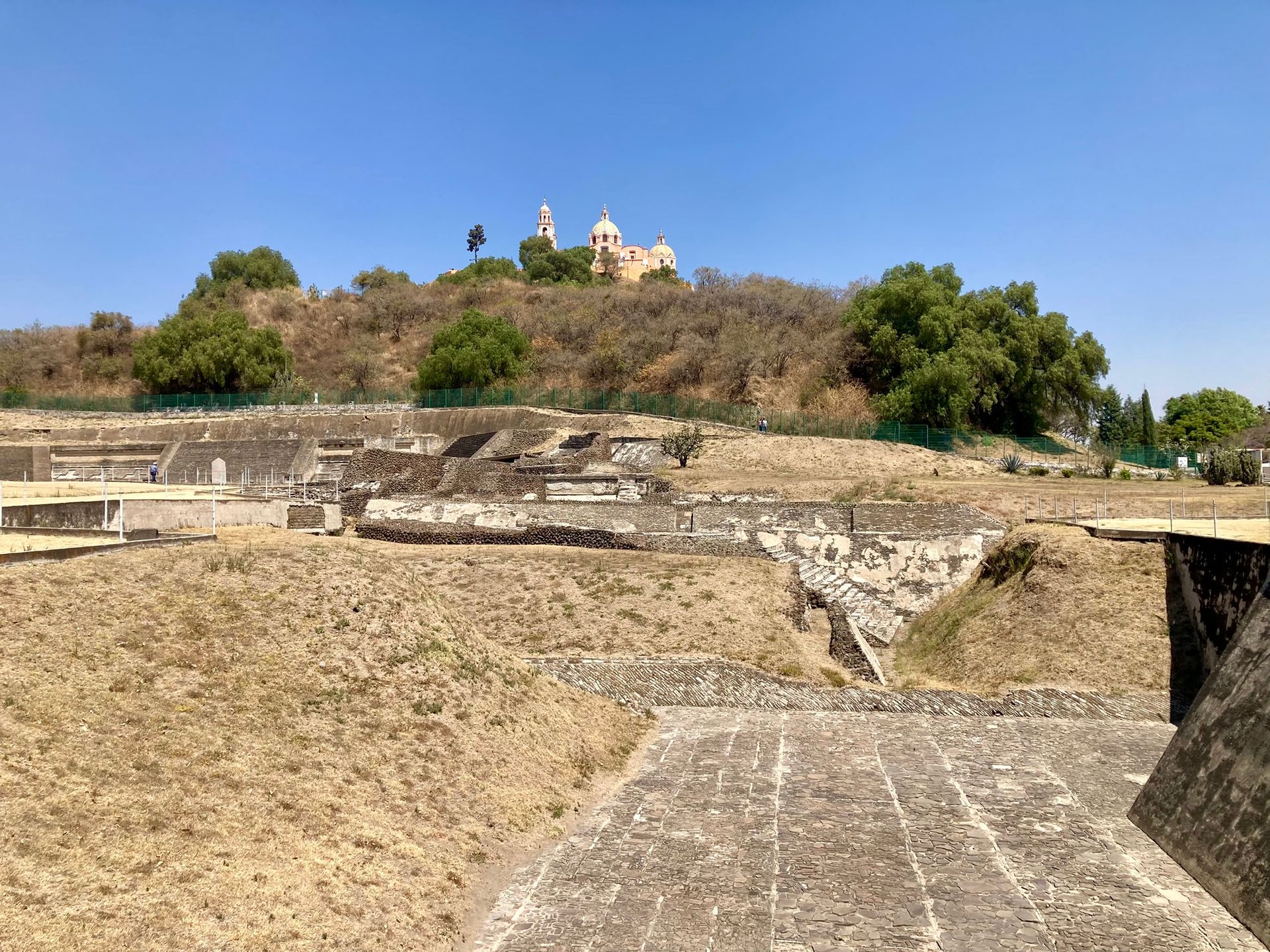
At first glance, it appeared to be a church on a hill: the Santuario de Nuestra Señora de los Remedios, serene and tiled, overlooking the plain. The hill was not a hill.
It was the Great Pyramid of Cholula.
When the Spanish arrived, the structure had been abandoned and overgrown. They did not recognise it as a pyramid and built their church on what they assumed was a natural rise.
Excavations beginning in 1910 revealed its true nature. Rather than dismantle it, archaeologists tunnelled through, eventually creating around eight kilometres of passages exposing earlier construction phases, murals and ceremonial spaces.
The tunnels were closed when we visited, but we explored the vast surrounding site and climbed a restored platform. A scale model in the museum made clear the pyramid’s vastness and its alignment with the landscape. Directly opposite the pyramid stood another grassy mound — still unexcavated, still reading as a hill.
Cholula was also a university town. The Universidad de las Américas Puebla gave the area a youthful energy, its students filling the bars and cafés. The combination — pyramid, colonial church, and international campus — felt unlike anywhere else.
Lunch was fabulous tacos at Caravana Cholula, then drinks later at La Pasita, known for its raisin liqueur. Back at the hotel, a string quartet played Stairway to Heaven, Coldplay, Queen and Taylor Swift in the courtyard.
— — —
The Museo Nacional de los Ferrocarriles Mexicanos is built around the former railway station, with platforms and ironwork intact. Much of the collection sits outdoors: steam engines, diesel locomotives, and carriages with brass fittings. One had been converted into a small library, where we were given paper birds folded around poems.
Puebla no longer has passenger rail services, which felt difficult to understand for a city of its size. In nearby Cholula, a modern station stood unused.
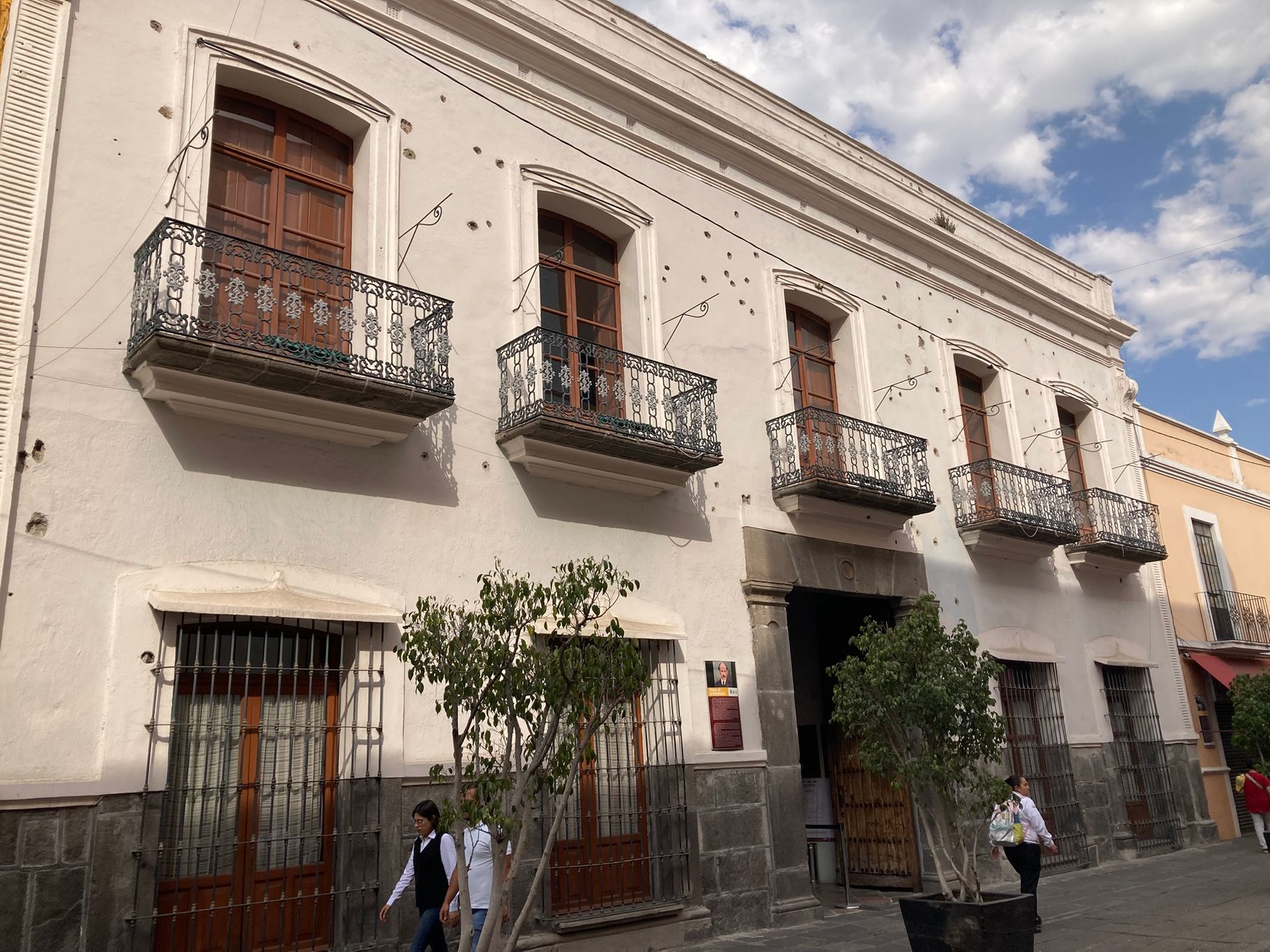
The Museo de la Revolución Mexicana — the Casa de los Hermanos Serdán — still bears bullet holes from 18 November 1910, when federal troops uncovered a planned uprising against Díaz. The damage remains visible in walls and mirrors. The revolution begins here not as abstraction, but as something immediate.
The pairing of railway museum and revolution house felt apt: one representing the confidence of the Díaz era, the other the moment it fractured.
Supper was tacos al pastor at Don Pastor Catedral, followed by pulque — cloudy, thick, faintly tangy — at a mezcalería near the hotel.
— — —
The Museo Amparo was the most impressive museum we visited in Puebla.
Downstairs, pre-Hispanic galleries displayed Olmec heads, Maya carvings and ceramic figures. One small section focused on Alfred Maudslay, an Englishman who documented Maya sites in the nineteenth century through photography and plaster casts.
Upstairs, an installation by Erick Meyenberg used a line from Christopher Columbus’s journal — written hours before landfall in 1492 — as its title. The birds he described suggested hope, but also marked the threshold of colonisation.
Another exhibition told the story of Stela 11 from Yaxchilán : transported in 1964 to Mexico City, lost, then rediscovered a year later by Gertrude Duby Blom on a riverbank, half submerged and used as a washing stone. It was returned, but never reinstated. Decades later, it remains where it was placed.
The Museo Amparo also explores the evolution of Mexican architecture over the past fifteen years. Through dozens of buildings from across the country, it highlights how architects balance design, context, and social purpose. The display includes sketches, models, and photographs, showing both the creative process and the finished structures, offering a clear view of how modern Mexican architecture shapes spaces and daily life.
We enjoyed lunch on the terrace at Museo Amparo, which afforded amazing views of the cathedral over the rooftops of the city, and the distant volcanoes.
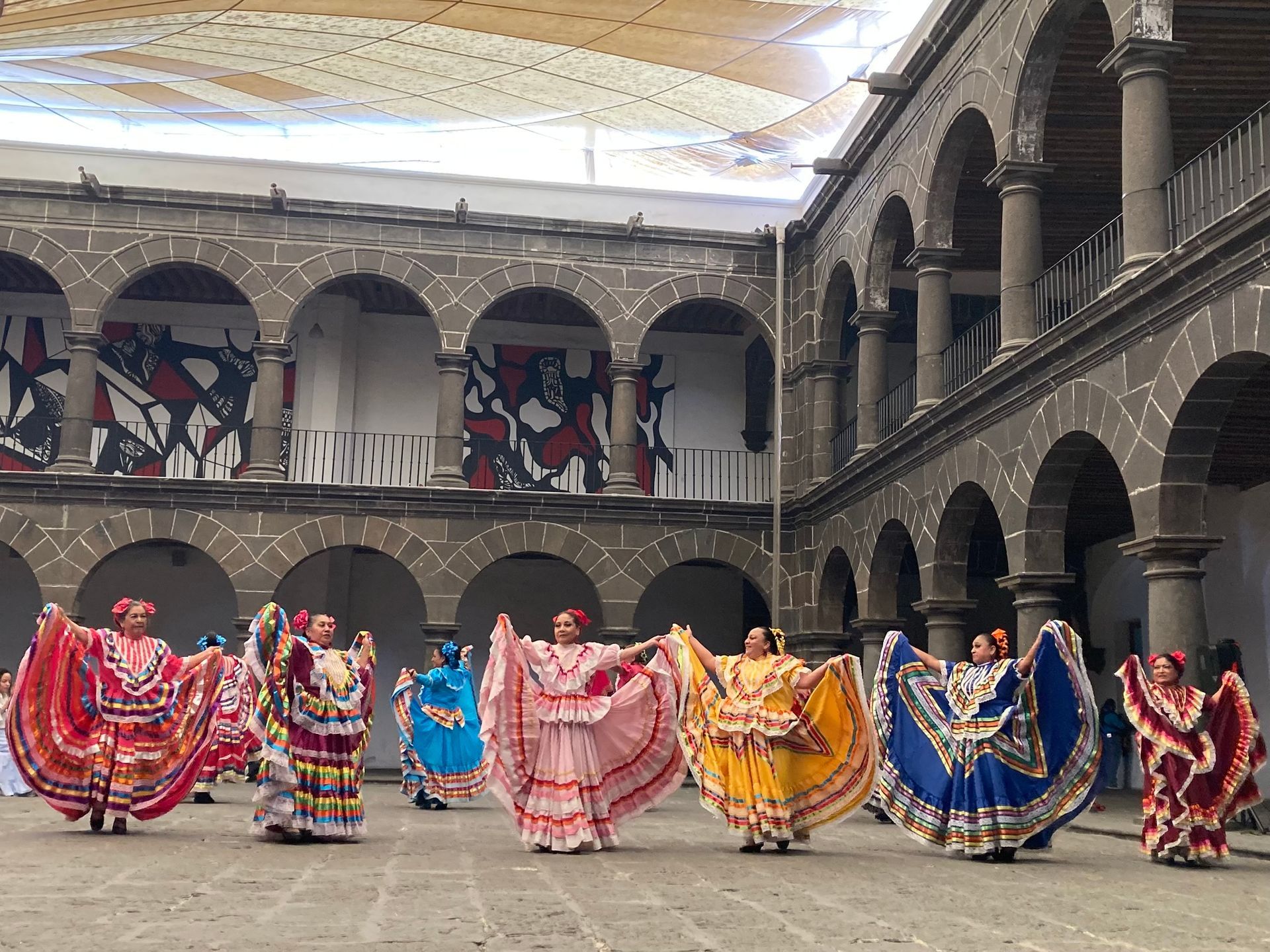
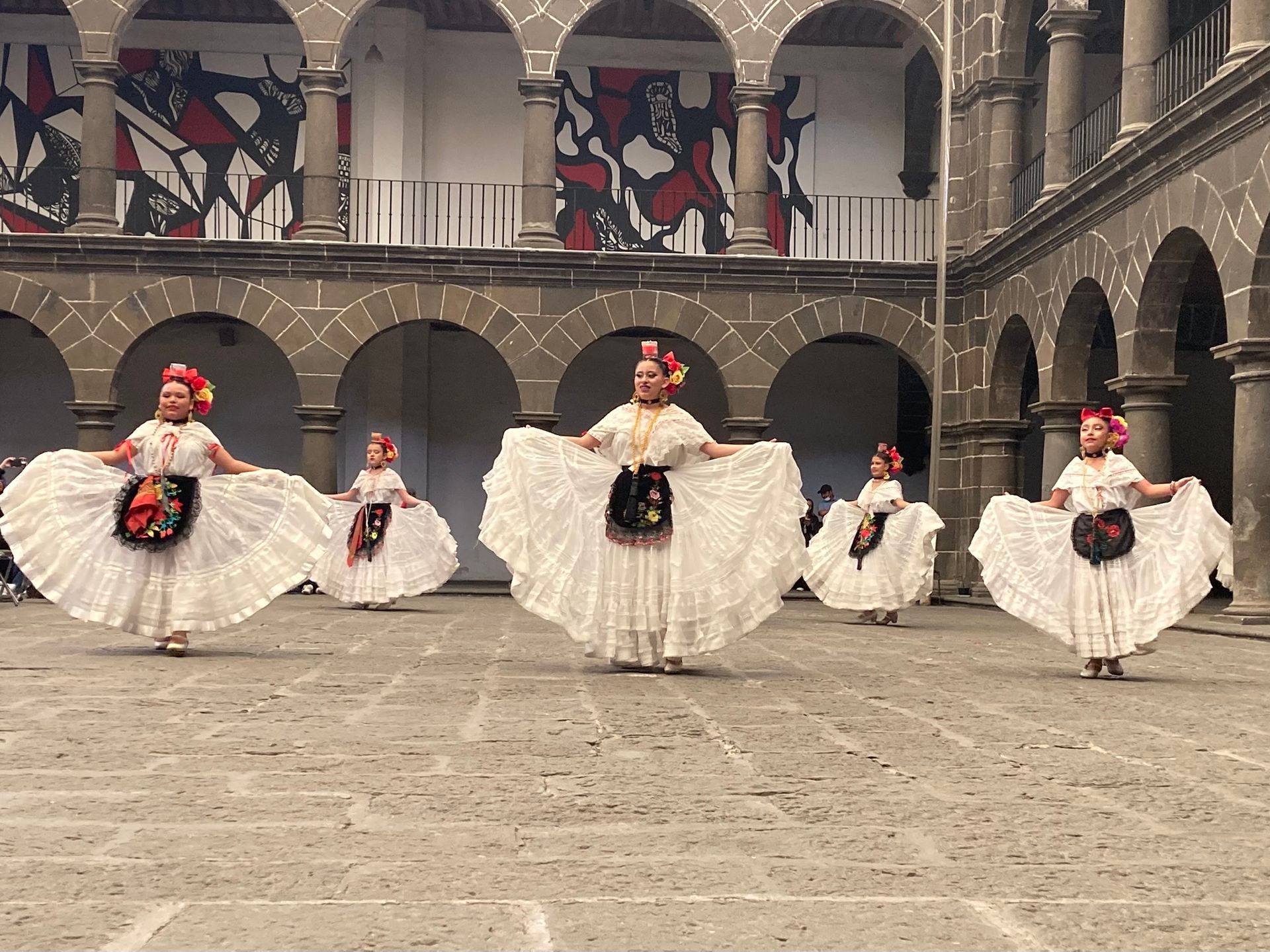
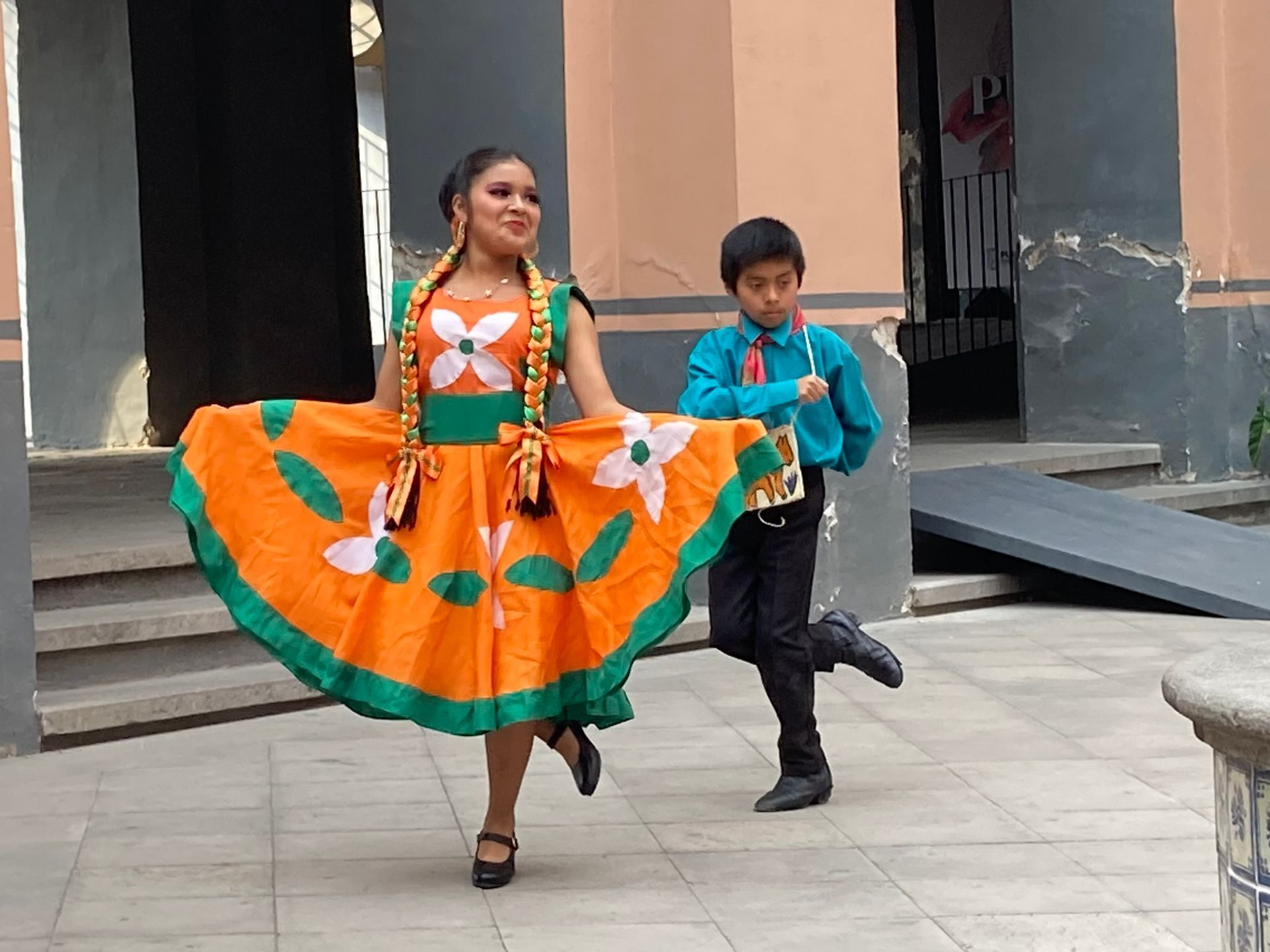
We then moved on to the Convento de Santa Rosa de Lima, a kitchen tiled entirely in blue-and-white Talavera stood out, along with a courtyard dance performance weaving ribbons into geometric patterns. There were also a range of interesting different exhibitions here from textiles to riding spurs.
Dinner at Augurio: three tortillas, each with a different mole. The mole poblano was deep and dark; the pipián rojo warm and nutty; the pipián verde fresh and herbal.
— — —
On our final morning, we had an hour before the bus and walked without a plan.
The Callejón de los Sapos street held antique shops and artists setting out prints and ceramics. We then sat for a while in the Zócalo as the cathedral bells marked the hour.
Two young police officers were standing nearby and we began talking. One spoke an indigenous language at home; the other spoke Korean and Japanese as well as Spanish and English. We compared notes on travel, laughed, and took a photograph together.
It was an ordinary conversation. It was also the thing we remembered most clearly from that last day.
Puebla had given us the Capilla del Rosario, the Biblioteca Palafoxiana, bullet holes in a revolutionary’s sitting room, steam engines in an open yard, three kinds of mole, and a string quartet playing Taylor Swift in a convent courtyard.
It was a very good week.
Then bags, and the bus. Hasta luego, Puebla y Mexico. We cannot wait to return.